Kuwait Military Forces
Kuwait ranks #49 of 170 militaries worldwide in 2026, with 17,500 active troops. The Kuwaiti Army fields 1,525 ground vehicles, including 585 main battle tanks; the Air Force flies 164 aircraft, including 82 combat aircraft; the Navy operates 20 warships. Kuwait has no nuclear weapons.

Armed Forces in 2026
| Domain | Strength | Composition |
|---|---|---|
| Kuwait Air Force | 164 aircraft | 82 combat 68 helicopters 3 air bases +35 on order |
| Kuwait Navy | 20 warships | |
| Ground Forces | 1,525 vehicles | 585 main battle tanks |
| Personnel | 17,500 active | 23,700 reserve 7,100 paramilitary |
ATLAS Index (Aggregate Total of Land, Air and Sea strength)
Full ranking →| Pillar | Weight | Score | Basis |
|---|---|---|---|
| Manpower | 10% | 31.5 | Active, reserve & paramilitary personnel |
| Ground forces | 20% | 46.4 | ARMS inventory power: armour & artillery by type and era, attack helicopters, armament |
| Naval power | 20% | 19.7 | SEAS inventory power: hulls by type, size and era, air wing, sustainment, armament |
| Air power | 25% | 34.7 | AIRS inventory power: aircraft by type and generation, enablers, armament |
| Nuclear deterrent | 10% | 0.0 | No declared nuclear capability |
| Defense budget | 15% | 30.4 | Annual spending, purchasing-power adjusted |
| Availability | modifier | ground ×0.98 · naval ×1.20 · air ×0.91 | Budget per point of each force, from the branch indexes |
Country File
| Population | 4.9M (2025) |
| GDP | $157.2 billion (2025) |
| GDP per capita | $32,312 |
| Military budget | $7.9B (2024) |
| Share of GDP | 4.9% (2024) |
| Military spending per capita | $1,614 (2024) |
| Inflation rate | 2.36% (2025) |
| Capital | Kuwait City |
| Region | Asia |
| Land area | 17,818 km² |
| Coastline | 499 km |
| Land borders | 462 km |
| Bordering countries | 2 |
| Currency | KWD |
Strategic Overview in 2026
Strategic Position
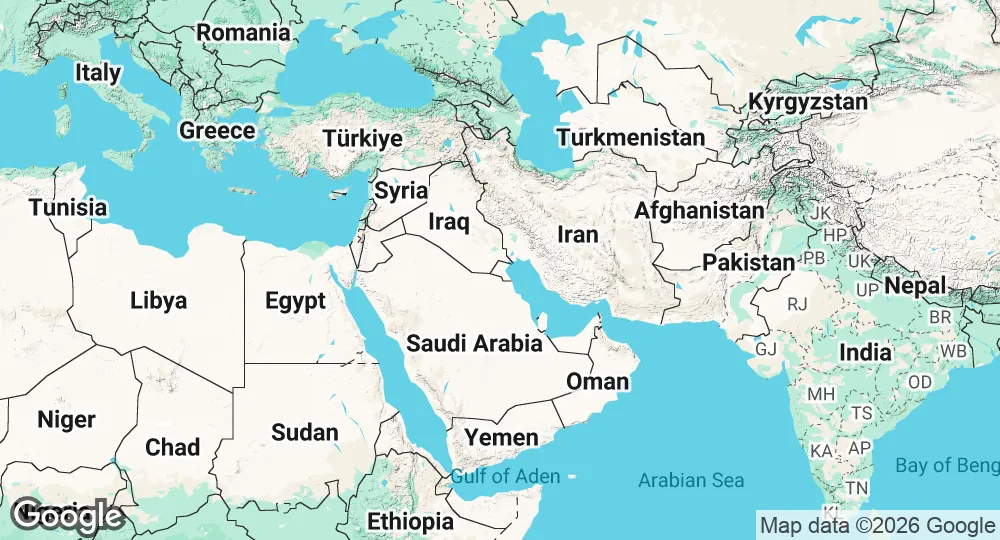
Kuwait occupies a coastal territory at the head of the Persian Gulf, bordering Iraq to the north and Saudi Arabia to the south. Its defense posture is defined by its proximity to these larger regional powers and its reliance on a network of international security guarantees. Kuwait is a founding member of the Gulf Cooperation Council (GCC) and has been designated as a Major Non-NATO Ally (MNNA) by the United States.
The primary framework for national security is the Defense Cooperation Agreement (DCA) with the United States, which facilitates a continuous presence of American forces at facilities including Camp Arifjan and Ali Al Salem Air Base. Kuwait also maintains bilateral defense treaties with the United Kingdom and France. Strategic priorities center on the maintenance of maritime sovereignty, the protection of oil infrastructure, and the prevention of regional instability. Current doctrine emphasizes a defensive-deterrent capability combined with high interoperability with Western and GCC partner forces.
Military Forces
The Kuwaiti Armed Forces are organized into three primary branches under the Ministry of Defense, with the Kuwait National Guard serving as an independent paramilitary organization. Total active-duty personnel are estimated at approximately 17,500, supported by a reserve force of roughly 25,000.
Kuwait Land Forces (KLF) The army is organized into armored, mechanized, and artillery brigades. The primary armored capability resides in the M1A2 Abrams main battle tank. Mechanized units operate Desert Warrior infantry fighting vehicles and M113-series armored personnel carriers. Artillery units utilize M109 self-propelled howitzers and PLZ-45 systems.
Kuwait Air Force (KAF) The KAF focuses on air superiority and ground attack missions. The fighter fleet consists of F/A-18C/D Hornets, which are being supplemented by F/A-18E/F Super Hornets and Eurofighter Typhoon Tranche 3 aircraft. Airlift requirements are met by C-17 Globemaster III and C-130J Hercules transport aircraft. The rotary-wing component operates AH-64D Apache Longbow attack helicopters and H225M Caracal utility helicopters for transport and search-and-rescue.
Kuwait Navy (KPN) The navy is a littoral force tasked with coastal defense and protecting offshore assets. The fleet includes Lürssen-class missile boats and various fast patrol craft equipped with anti-ship missiles. The Kuwait Coast Guard, which falls under the Ministry of Interior, maintains a separate fleet of patrol vessels for maritime law enforcement and border security.
Specialized Units The 25th Commando Brigade is the primary special operations unit, trained for counter-terrorism and unconventional warfare. The military also maintains dedicated chemical, biological, radiological, and nuclear (CBRN) defense units to address regional proliferation risks.
Defense Industry
Kuwait possesses a limited domestic defense manufacturing sector and relies on Foreign Military Sales (FMS) for almost all major platforms. Domestic industrial activity is concentrated in maintenance, repair, and overhaul (MRO) services. The Kuwait Integrated Maintenance and Services (KIMS) provides technical support for land systems. Government policy utilizes offset programs to require foreign defense contractors to establish local training centers and technical facilities, aiming to increase the technical proficiency of the local workforce.
Strategic Trends
Current modernization programs prioritize the integration of advanced aviation platforms and the upgrading of existing land systems. The acquisition of Eurofighter Typhoons and F/A-18E/F Super Hornets represents a transition toward advanced sensor fusion and networked warfare. For the Land Forces, the focus is on the modernization of the M1A2 fleet to the SEPv3 standard to improve survivability and electronic architecture.
Defense spending is approximately 3% to 4% of GDP. A primary constraint is the heavy reliance on foreign technical contractors for the maintenance of sophisticated systems. Current force structure shifts involve the expansion of the Kuwait National Guard's role in border security and critical infrastructure protection. In 2025 and 2026, the military has intensified its focus on cyber defense capabilities, establishing specialized units to protect military networks and national infrastructure from non-kinetic threats. Professionalization of the officer corps through training programs in the United States and United Kingdom remains a consistent priority to ensure operational readiness alongside coalition partners.
Military Expenditure: CIA World Factbook. Last updated on 25 September 2026. Suggest a change
Frequently Asked Questions
How large is Kuwait's military?
What is Kuwait's defense budget?
How does Kuwait rank militarily in the world?
Does Kuwait have nuclear weapons?
How many aircraft does Kuwait's air force have?
How large is Kuwait's navy?
How many tanks does Kuwait have?
What percentage of GDP does Kuwait spend on defense?
What is Kuwait's military personnel per capita?
Does Kuwait have paramilitary forces?
- SEP 252026 Updated Population, GDP and inflation added for 2025; GDP series revised
- AUG 42026 Updated Global Military Index updated in a site-wide editorial pass
- AUG 32026 Updated Global Military Index updated
- JUL 242026 Updated Global Military Index updated
- JUL 162026 Updated Global Military Index updated in a site-wide editorial pass
- JUL 22026 Updated Rank insignia and ranks overview added
- JUN 162026 Updated Yearly statistics, military spending and 2 more fields updated