Strategic Position
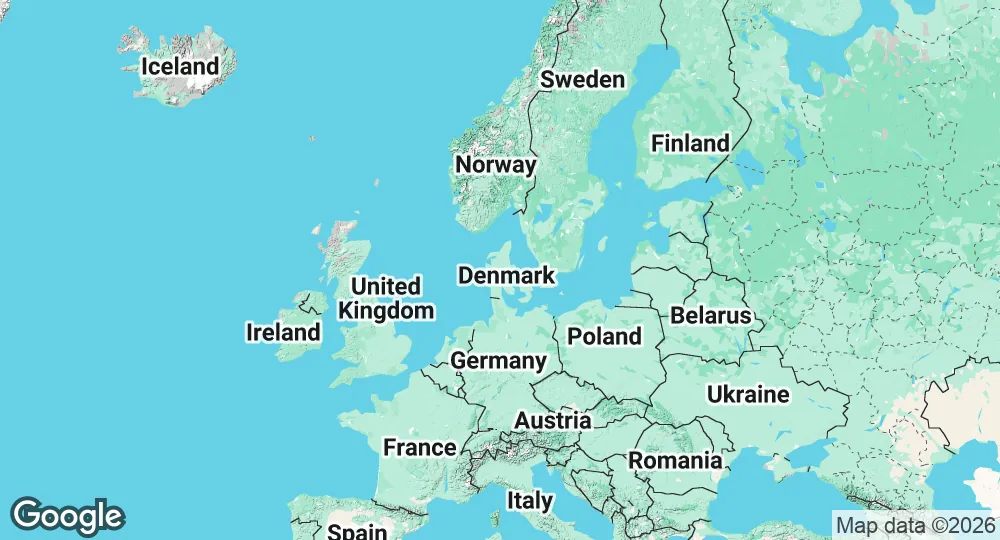
Denmark's defense policy is defined by its membership in NATO and the Nordic Defence Cooperation (NORDEFCO), with a primary focus on the security of the Baltic Sea, the North Atlantic, and the Arctic. The Kingdom of Denmark maintains sovereignty over Greenland and the Faroe Islands, necessitating a specialized Arctic posture. Command of these regions is centralized under the Joint Arctic Command (AKO), headquartered in Nuuk, Greenland.
National security doctrine has transitioned toward high-intensity conventional deterrence. Strategic assessments in 2025 identified a requirement for rapid rearmament to counter emerging territorial threats in the Baltic region. Denmark acts as a critical transit point for Allied reinforcements moving into the Baltic Sea through the Danish Straits. Bilateral agreements with the United States and other NATO partners facilitate the hosting of allied personnel and equipment for regional exercises and infrastructure protection.
Military Forces
The Danish Defence (Forsvaret) is organized into the Army, Navy, Air Force, and Home Guard, with specialized units under the Special Operations Command (SOCOM). The total strength includes approximately 16,000 active-duty personnel and 45,000 reserve and Home Guard personnel. Starting in 2026, Denmark implemented a revised conscription model that extends service duration to 11 months and mandates service for both men and women.
Army
The Royal Danish Army is structured around the 1st Brigade, which is undergoing transition into a heavy mechanized brigade to meet NATO capability targets. The 2nd Brigade focuses on training and recruitment.
-
Armored Vehicles: Leopard 2A7 main battle tanks, CV9035 infantry fighting vehicles (including recently ordered Mk IIIC variants), and Piranha V armored personnel carriers.
-
Support Systems: ATMOS self-propelled howitzers and PULS rocket artillery systems, acquired to replace assets transferred to Ukraine. The army also operates Patria 6x6 armored personnel carriers for light infantry and support roles.
Navy
The Royal Danish Navy emphasizes maritime surveillance and anti-submarine warfare (ASW).
-
Surface Combatants: Iver Huitfeldt-class frigates (primary air defense) and Absalon-class frigates (ASW and tactical support).
-
Arctic and Patrol Vessels: Knud Rasmussen-class and Thetis-class ocean patrol vessels.
-
Specialized Capabilities: Modular "Cube" systems for mine-laying and environmental tasks. Efforts are underway to enhance surveillance of critical undersea infrastructure via autonomous underwater vehicles and new sonar-equipped vessels.
Air Force
The Royal Danish Air Force is in the final stages of transitioning to a fifth-generation fleet.
-
Combat Aircraft: F-35A Lightning II fighters, which assumed national Quick Reaction Alert (QRA) duties in 2025. The legacy F-16 fleet is being phased out, with units being donated to Ukraine or sold.
-
Transport and Rotary Wing: C-130J-30 Super Hercules transport aircraft, EH101 Merlin helicopters (search and rescue/transport), and MH-60R Seahawk helicopters (maritime operations).
Defense Industry
The Danish defense industry is characterized by niche expertise in electronics, radar, and modular maritime systems. Domestic production is primarily geared toward export and integration into international platforms rather than total self-sufficiency.
-
Key Manufacturers: Terma A/S produces aerostructures and radar systems, including essential components for the global F-35 program. Weibel Scientific specializes in high-precision Doppler radars for flight testing and missile defense. Systematic provides C4I (Command, Control, Communications, Computers, and Intelligence) software used by numerous NATO members.
-
International Cooperation: Denmark relies on foreign imports for heavy platforms, such as tanks from Germany and fighters from the United States. Industrial cooperation agreements often require foreign suppliers to partner with Danish firms for maintenance and component manufacturing.
Strategic Trends
Defense spending reached approximately 3% of GDP in 2025, supported by the DKK 190 billion 2024–2033 Defense Agreement and a supplementary "Acceleration Fund." This fund is designed to fast-track the procurement of ground-based air defense (GBAD) systems and long-range surveillance drones for the Arctic.
Modernization priorities include the full operational capability of the F-35A fleet and the establishment of a combat-ready heavy brigade by 2028. The reintroduction of expanded conscription aims to increase annual recruit numbers to 7,500 by the end of the decade. Additionally, the military is intensifying its presence in Greenland, upgrading infrastructure at Kangerlussuaq and Nuuk to support increased allied deployments and persistent Arctic surveillance.