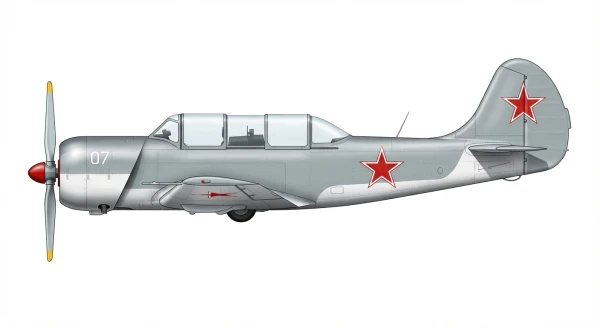
Yak-52
Soviet primary trainer aircraft, renowned for its extensive service in DOSAAF training program during the late 20th century. Key figures: top speed 285 km/h, range 550 km, service ceiling 4,000 m, max takeoff weight 1,305 kg, built 1,815. In service with 2 air forces as of 2026 — Vietnam (24), Romania (14).
| Length | 7.7 m (25.4 ft) |
| Wingspan | 9.3 m (30.5 ft) |
| Height | 2.7 m (8.9 ft) |
| Wing area | 15 m² (161.5 sqft) |
| Empty weight | 1,015 kg (2,238 lbs) |
| Max. takeoff weight | 1,305 kg (2,877 lbs) |
| Powerplant | 1 × radial engine Vedeneyev M14P 265 kW each |
| Maximum speed | 285 km/h (177 mph) |
| Operational range | 550 km (342 mi) |
| Service ceiling | 4,000 m (13,123 ft) |
| Climb rate | 7.0 m/s (23.0 ft/s) |


1 loss recorded here in the Russia-Ukraine War.
Description
The Yakovlev Yak-52 is a Soviet two-seat primary and aerobatic trainer that first flew in 1976 and entered service in 1979. It was designed for DOSAAF, the Soviet paramilitary organisation that trained both sport pilots and military candidates, and almost all production was carried out under COMECON licence in Romania by Aerostar, which built the aircraft as the Iak-52 from 1977 until 1998 — an estimated 1,815 airframes in 121 production batches, the thousandth delivered in 1986 and the fifteen-hundredth in 1990. Rugged, fully aerobatic and cheap to operate, it remains in military, sport and private use decades after the organisation it was built for disappeared — and, unexpectedly, it has been pressed into a combat role in Ukraine.
Design
The Yak-52 descends from the single-seat competition aerobatic Yak-50. It is an all-metal tandem two-seater powered by a 268 kW (360 hp) Vedeneyev M-14P nine-cylinder radial driving a two-bladed variable-pitch wood and fibreglass propeller that turns counter-clockwise. Because the aircraft was meant to prepare students for military types, its layout deliberately mirrors that of early post-war fighters: the tandem cockpit, instrument panel, seat design and canopy mechanism, the tail, the tricycle undercarriage, the mixed monocoque and steel-tube fuselage construction, the inboard flaps and the control positions all echo the Yak-17UTI jet trainer, whose overall dimensions the Yak-52 nearly matches.
Fuel and oil systems allow up to two minutes of inverted flight. At 1,015 kg empty the aircraft is stressed to +7 and −5 g, rolls to the right at well over 180 degrees per second, and can fly every manoeuvre in the Aresti catalogue, which is why it has been used in international competition to Advanced level.
Its most distinctive engineering feature is pneumatic rather than hydraulic actuation: engine starting, landing gear, flaps and brakes all run on compressed air stored in spherical bottles behind the rear cockpit and replenished by an engine-driven compressor, at pressures between 10 and 50 bar. An emergency circuit is reserved for lowering the undercarriage if the main supply is exhausted, and the bottles can be recharged on the ground from a scuba-type cylinder. Braking is differential, controlled by the rudder pedals together with a lever on the control stick, an arrangement that takes adjustment for pilots used to Western hydraulics. The retractable tricycle gear remains partly exposed when retracted, which adds useful drag in downward manoeuvres and gives some protection in a wheels-up landing.
Operational History
The Yak-52 became the standard DOSAAF primary trainer and spread across the Warsaw Pact and the wider Soviet sphere. Military operators have included Armenia, Belarus, Bulgaria, Georgia, Latvia, Lithuania, Romania, Russia, Turkmenistan, Ukraine and Vietnam. Today the Romanian Air Force is the only remaining military operator with a meaningful fleet, about fourteen aircraft, though the type continues in DOSAAF and civil sport flying and is the aircraft of the FAI's one-design Yak-52 World Aerobatic Championship.
The Russian invasion of Ukraine gave the Yak-52 an unforeseen second career. Although unarmed by design, Ukrainian crews have used it to intercept Russian reconnaissance drones, a gunner in the rear seat engaging the target at close range while the aircraft's low stall speed lets the pilot match the drone's speed and manoeuvre with it. A Yak-52 shot down an Orlan-10 over Odesa in April 2024 and a ZALA drone on 8 June 2024; imagery circulated on social media suggests at least one airframe has accounted for up to eight drones. Russian units have employed the type in the same role.
Variants
- Yak-52 — the baseline two-seat trainer with the 360 hp M-14P.
- Yak-52B — a light ground-attack version armed with two UB-32-57 rocket pods for S-5 rockets.
- Yak-52M — a 2003 modernisation with the M-14Kh engine, a three-bladed propeller, new avionics and a crew escape system, first flown on 16 April 2004.
- Iak-52, Iak-52W, Iak-52TW, Iak-52TD — Romanian-built versions from Aerostar, the later ones westernised with Western instruments, the more powerful M-14PF or M-14Kh, a three-bladed propeller and, on the TW and TD, tailwheel undercarriage and enlarged fuel tanks.
- UTL-450 — a turboprop conversion presented by Motor Sich in 2016 with the AI-450S engine.
Frequently Asked Questions
What type of aircraft is the Yak-52?
What is the maximum speed of the Yak-52?
What is the range of the Yak-52?
When did the Yak-52 first fly?
How many Yak-52 have been built?
Which countries operate the Yak-52?
What is the service ceiling of the Yak-52?
- AUG 302026 Updated Reworded the remaining-operators sentence of the overview
- AUG 52026 Updated Description and number built updated
- APR 72026 Updated Picture credits updated in a site-wide editorial pass
- FEB 72026 Updated Top speed added
- JAN 122026 Updated Range updated in a site-wide editorial pass