AW149
Italian medium-lift military helicopter, developed in the 2000s, largely envisaged for troop transport and medical evacuation missions. Key figures: top speed 310 km/h, range 1,009 km, service ceiling 6,095 m, max takeoff weight 8,600 kg, unit price $16M, built 31. In service with 3 air forces as of 2026 — Egypt (33), Poland (11), Thailand (5).
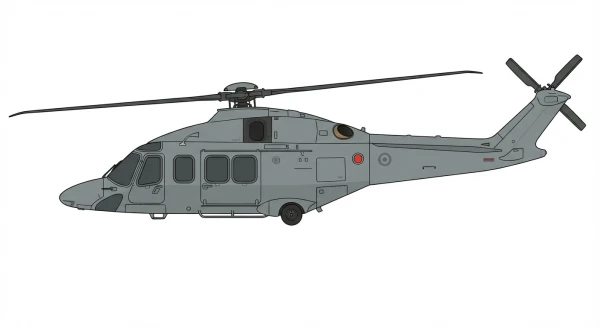
| Length | 17.6 m (57.6 ft) |
| Wingspan | 14.6 m (47.9 ft) |
| Height | 5.1 m (16.9 ft) |
| Empty weight | 4,720 kg (10,406 lbs) |
| Max. takeoff weight | 8,600 kg (18,960 lbs) |
| Powerplant | 2 × turboshafts General Electric CT7-3E1 1,476 kW each |
| Maximum speed | 310 km/h (193 mph) |
| Operational range | 1,009 km (627 mi) |
| Service ceiling | 6,095 m (19,997 ft) |


- Air-to-Air Short-Range General Dynamics AIM-92 Stinger
- Anti-Tank Lockheed-Martin AGM-114 Hellfire
- Air-to-Air Short-Range Mistral
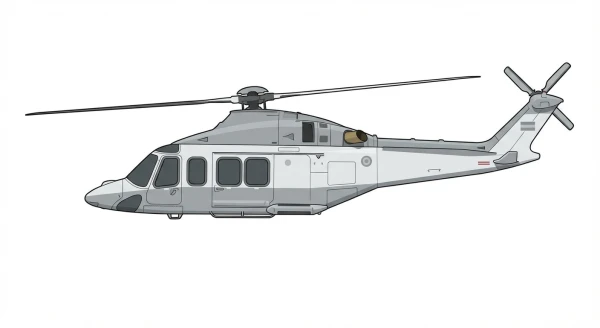
Description
The AW149 was conceived as a new, purpose-built military helicopter design. Formally launched in 2006 by AgustaWestland, now Leonardo, it was intended to offer increased cargo volume and payload capacity compared to the AW139 through a larger fuselage and more powerful engines. The first prototype achieved its initial flight on November 13, 2009, at AgustaWestland's Vergiate facility in northern Italy. A second prototype, equipped with production-standard engines, followed with its first flight on February 26, 2011, also from Vergiate. By 2014 the design had achieved military certification.
Design
Conceived as a military design, the AW149 is distinguished by a larger fuselage and more powerful engines compared to the AW139, thereby increasing its cargo volume and payload capacity. Military certification includes the ability of its landing gear to sustain a touchdown with a sink speed of 9.5 m/s, significantly higher than the 2 m/s for a civilian helicopter. Its open architecture allows for adaptable avionics configurations. The helicopter is equipped with four hardpoints.
Armament
The AW149 features four hardpoints that can accommodate various weapon configurations. These include missile launching pods, each capable of carrying four AGM-114 Hellfire II missiles, and rocket launching pods, such as the FZ231 pod carrying 12 x 70 mm rockets. The hardpoints can also be configured to carry external fuel tanks, extending the helicopter's operational range.
Operational History
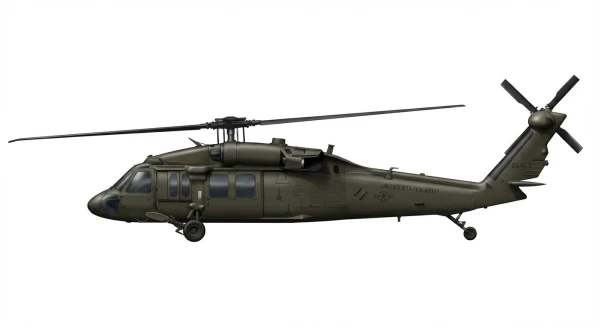
The AW149 has seen operational use with the Egyptian Navy, which ordered 24 in 2019 with deliveries beginning in late 2020, and with the Royal Thai Army and Royal Thai Police. The helicopter is being marketed as an alternative to the Sikorsky UH-60 Black Hawk family, and was a contender in the Turkish Utility Helicopter Program, though it was ultimately not selected. It is also proposed for the UK's New Medium Helicopter programme. Poland has ordered 32 AW149 helicopters, with deliveries planned from 2023 to 2029 and local production starting in 2024. North Macedonia has also placed an order for the AW149. Leonardo has offered the AW149 to Malaysia.
Variants
Main Variants:
-
AW149: The baseline multi-role military helicopter, designed for troop transport, combat operations, and search and rescue missions.
-
TUHP149: A version of the AW149 submitted for the Turkish Utility Helicopter Program, featuring specific modifications to meet Turkish Armed Forces requirements.
-
AW189: A civilian development of the AW149, adapted for commercial operations, with service beginning in 2013.
Frequently Asked Questions
What type of aircraft is the AW149?
What is the maximum speed of the AW149?
What is the range of the AW149?
When did the AW149 first fly?
How many AW149 have been built?
Which countries operate the AW149?
How much does a AW149 cost?
What is the service ceiling of the AW149?
- AUG 52026 Updated Powerplant updated in a site-wide editorial pass
- APR 82026 Updated Empty weight added
- APR 72026 Updated Sources and cross-references refreshed
- FEB 72026 Updated Wingspan added
- JAN 122026 Updated Range updated in a site-wide editorial pass