Whiskey-class
Ex-USSR submarine, introduced in 1951, displaced 1,050 tons, and had a crew of 52 sailors. Key figures: displacement 1,050 tons, length 76 m, top speed 18 knots, crew 52, built 236. No longer in service; operated by 7 navies over its career.
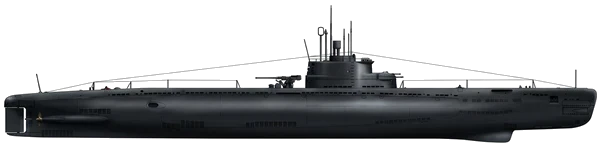
| Subtype | Diesel-electric attack submarine |
| Displacement | 1050 tons |
| Displacement submerged | 1340 tons |
| Crew | 52 members |
| Width | 6.5 m (21.3 ft) |
| Length | 76.0 m (249.3 ft) |
| Max. depth | 200 m (656.2 ft) |
| Propulsion | Two-shaft diesel–electric: 2 × 2,000 bhp (1,500 kW) diesel engines, 2 × 1,350 hp (1,010 kW) main electric motors, 2 × 50 hp (37 kW) electric creep motors |
| Units | S-189, S-80, S-178, S-363, S-194, S-290, KRI Pasopati (410) |
| Range | 8,580 nm at 10 knots |
| Endurance | 7 days |
| Maximum speed | 18 knots |
| Max. speed submerged | 13 knots |
- 6 × 533 mm (21 in) torpedo tubes (4 bow + 2 stern)
- 12 × torpedoes or 22 × mines
- 1 × single-mounted 25 mm (1.0 in) AA gun
- 2 × single-mounted 57 mm (2.2 in) AA gun
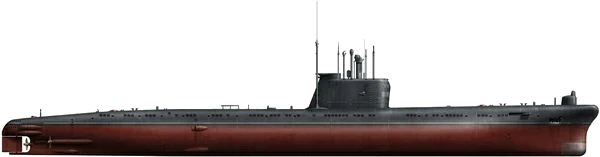
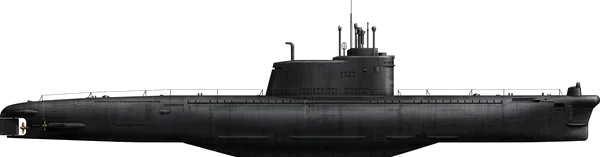
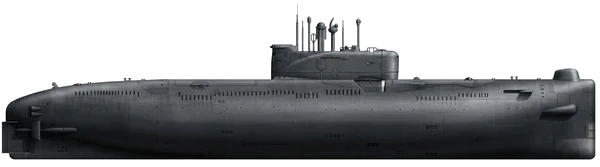
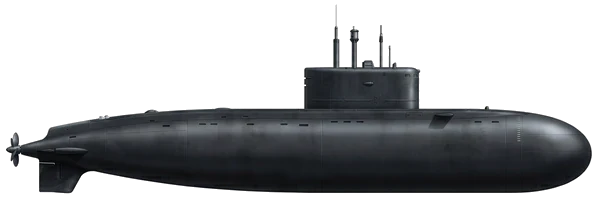
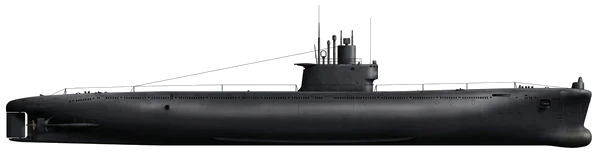
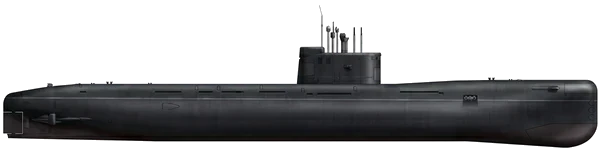
Description
The Whiskey class, designated Projects 613, 640, 644, and 665 in the Soviet Union, originated from a design requirement issued in 1946. Developed by the Lazurit Design Bureau in Gorkiy, the design was a successor to the S-class and incorporated technology from the German Type XXI U-boat. Between 1950 and 1958, the Soviet Union produced 215 units, while China built or reassembled additional vessels between 1956 and 1960.
The class consists of diesel-electric attack submarines initially designed for coastal patrol. Design iterations progressed through five primary patrol variants. Early configurations featured deck-mounted anti-aircraft guns, while later variants removed deck armament in favor of snorkels and streamlined conning towers. During the 1950s and 1960s, several hulls were converted to carry cruise missiles. These missile variants included the Single Cylinder, Twin Cylinder (Project 644), and Long Bin (Project 665) versions. These vessels were required to surface to launch their armament; the Long Bin modification utilized an extended sail to house missiles but experienced stability and noise issues. Other hulls were modified for radar picket duties and intelligence gathering.
The Whiskey class was operated by the navies of the Soviet Union, Albania, Bulgaria, China, Egypt, Indonesia, North Korea, and Poland. In the Soviet Navy, the class was replaced by the Romeo class for patrol duties and the Juliett class for missile operations. Service events include the loss of S-80 in 1961 due to a snorkel valve failure, the collision of S-178 with a merchant vessel in 1981, and the 1981 grounding of S-363 near the Karlskrona naval base in Sweden. The Soviet Union maintained 45 vessels on active status as late as 1982, with the final units decommissioned in the early 1990s. Several vessels are preserved as museum ships, including S-189 in Saint Petersburg and KRI Pasopati in Surabaya.
Frequently Asked Questions
What type of ship is the Whiskey-class?
What is the displacement of the Whiskey-class?
What is the maximum speed of the Whiskey-class?
What is the range of the Whiskey-class?
How many crew members serve on the Whiskey-class?
How many Whiskey-class ships have been built?
Which countries operate the Whiskey-class?
- JUL 242026 Updated Type updated
- JUL 232026 Updated Sources and cross-references refreshed
- APR 72026 Updated Description updated in a site-wide editorial pass
- JAN 182026 Updated Units and range at cruise speed added; type, manufacturer and 9 more fields updated