HK-33
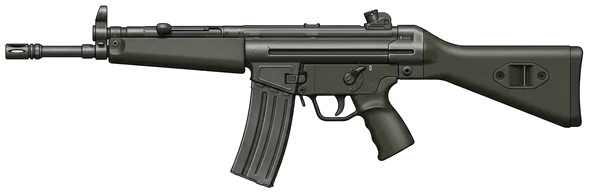
| Fire rate | 750 rounds/min. |
| Caliber | 5.56 x 45 mm NATO |
| Magazine | 25 - 30 - 40 rounds |
| Length | 920 mm (36.2 in) |
| Weight | 3.6 kg (7.9 lb) |
| Range | 400 m (1312 ft) |
Description
Heckler & Koch GmbH of Oberndorf developed the HK33 during the 1960s, primarily for export markets. It formed part of a family of small arms derived from the G3, all sharing the same operating principle and basic design concept, comprising models chambered for 7.62×51mm NATO, the Soviet 7.62×39mm M43 round, .223 Remington and 5.56×45mm NATO, and the 9×19mm Parabellum pistol cartridge. Commercially the HK33 sold well, though never matching the volume of the G3. Licence production was established in Thailand, Malaysia, Greece by EAS, and Turkey by MKEK; rifles were also exported from France under the MAS brand despite being manufactured in Germany.
The HK33 is a selective-fire weapon using Heckler & Koch's roller-delayed blowback system. A two-piece bolt consists of a bolt head carrying a pair of rollers and a bolt carrier. On firing, the rollers are cammed inward by the inclined surfaces of the barrel extension, driving the locking piece and bolt carrier rearward; the resulting mechanical disadvantage delays the bolt head relative to the faster-moving carrier. Once the rollers retract fully into the bolt head and clear the barrel extension recesses, both parts travel rearward together to open the breech. The G3 mechanism was downsized and its transmission geometry revised for the 5.56×45mm cartridge. Because the chamber opens under high pressure, it is fluted to aid initial extraction. An anti-bounce device, a spring-loaded bolt head locking lever on the carrier, prevents rebound as the bolt goes into battery. The ejector lever sits in the trigger housing and is actuated by the recoiling bolt. Heckler & Koch supplied locking pieces of differing mass and shoulder angle to adjust unlock timing for varying ammunition and barrel parameters. The rifle is modular: butt-stock, fore-stock and pistol grip/fire control assembly are retained by push-pins and can be exchanged. Trigger packs available include a standard ambidextrous safe/semi/automatic group, a burst-capable group, the Navy unit and a four-position group. Feeding is from steel, aluminium or, on Turkish rifles, polymer magazines. The barrel has six right-hand grooves and a slotted flash suppressor permitting rifle grenade launching and mounting of the G3-pattern bayonet. Sights consist of a hooded front post and a rotary rear drum with an open V-notch and three apertures, adjustable for windage and elevation with tools only. Receiver recesses accept STANAG claw mounts and HK clamp adapters for the Hensoldt Fero 4×24 telescopic sight or night optics. Accessories include a detachable bipod, sling, cleaning kit, magazine loader, blank-firing adaptor and the HK79 under-barrel grenade launcher.
The base HK33 had a fixed stock; the HK33A1 introduced a retractable stock and the HK33K a shortened carbine barrel that precluded bayonet and rifle grenade use. The HK33A2 strengthened the fixed stock and adopted a handguard accepting a stowable bipod, with the HK33A3 as its telescoping-stock counterpart and the HK33KA2 and KA3 as carbines. The HK33ZF and HK33A2ZF carried 4× optics, while the HK33SG/1 was an accurised model with telescopic sight and improved trigger. Later production used the E suffix for export. Related weapons include the compact HK53, the magazine-fed HK13 light machine gun and the belt-fed HK23.
Harrington & Richardson built the T223 under licence in the mid-1960s for the US smallbore rifle trials, differing in selector markings, bipod attachment and magazine. It was trialled by Navy SEALs in Vietnam with 40-round magazines, but cost, lack of M16 compatibility and preference for American designs prevented adoption; it left the H&R catalogue after 1967.
Thailand has manufactured the Type 11 derivative since 1968, including a bullpup variant with M16 sights. Myanmar produced the MA-11 rifle and MA-12 light machine gun through KaPaSa with Myanmar Fritz Werner Industries. Brazil adopted the HK33 and HK33A1 for the Air Force in 1971 to replace the M1 Carbine, with HK33A2 and HK53A5 issued to the 1º Batalhão de Forças Especiais. Turkey produced the HK33E as the M79 from 1981 as the standard Turkish Land Forces rifle, now being replaced by the MPT-55. Other users include Chile, Ecuador, El Salvador, Ghana, Greece, Guatemala, Indonesia, Iran, Ireland, Luxembourg, Malaysia, Mexico, the Netherlands, Papua New Guinea, Peru, the Philippines, Portugal, Saudi Arabia, Senegal, South Africa, Spain, Sweden, Tanzania and East Timor. The HK53 served with the British armed forces as the L101A1, with Royal Military Police Close Protection Units, 14 Intelligence Company, Close Observation Platoons and the SAS in Northern Ireland, before replacement by the C8 SFW and C8 CQB in the early 2000s. The HK33SG/1 was used by the East German Diensteinheit IX counter-terrorism unit. The rifle saw use by Thai government forces during the South Thailand insurgency, with captured examples appearing with the Patani United Liberation Organisation and the Gerakan Mujahidin Islam Patani, and by the Karen National Liberation Army and People's Defence Force in Myanmar. The Kurdistan Workers' Party has claimed captures from Turkish forces.
Semi-automatic sporting derivatives comprise the HK43, a civilian version of the HK33A2 retaining the bayonet mount and military furniture, succeeded by the HK93A2 and HK93A3, which incorporated a redesigned trigger pack and a blocking shelf preventing installation of a full-automatic group. Century International Arms produced the C-93 from Thai Type 11 parts kits with American-made barrels.
Frequently Asked Questions
What type of firearm is the HK-33?
What caliber is the HK-33?
What is the effective range of the HK-33?
What is the rate of fire of the HK-33?
What magazine does the HK-33 use?
How heavy is the HK-33?
- AUG 302026 Updated Description updated
- JUL 232026 Updated Service entry year updated in a site-wide editorial pass
- JUN 122026 Updated Caliber updated
- APR 82026 Updated Sources and cross-references refreshed