Zimbabwe Military Forces
Zimbabwe ranks #110 of 169 militaries worldwide in 2026, with 29,000 active troops. The Zimbabwean Army fields 15 main battle tanks; the Air Force flies 83 aircraft, including 21 combat aircraft. Landlocked, Zimbabwe has no navy and no nuclear weapons.
Armed Forces in 2026
| Domain | Strength | Composition |
|---|---|---|
| Air Force of Zimbabwe | 83 aircraft | 21 combat 29 helicopters +12 on order |
| Ground Forces | 15 tanks | |
| Personnel | 29,000 active | 21,800 paramilitary |
ATLAS Index (Aggregate Total of Land, Air and Sea strength)
Full ranking →| Pillar | Weight | Score | Basis |
|---|---|---|---|
| Manpower | 10% | 30.9 | Active, reserve & paramilitary personnel |
| Ground forces | 20% | 17.7 | ARMS inventory power: armour & artillery by type and era, attack helicopters, armament |
| Naval power | 20% | 0.0 | SEAS inventory power: hulls by type, size and era, air wing, sustainment, armament |
| Air power | 25% | 18.2 | AIRS inventory power: aircraft by type and generation, enablers, armament |
| Nuclear deterrent | 10% | 0.0 | No declared nuclear capability |
| Defense budget | 15% | 11.6 | Annual spending, purchasing-power adjusted |
| Availability | modifier | ground ×0.80 · naval ×1.00 · air ×0.80 | Budget per point of each force, from the branch indexes |
Country File
| Population | 17M (2025) |
| GDP | $51.2 billion (2025) |
| GDP per capita | $3,021 |
| Military budget | $166M (2024) |
| Share of GDP | 0.4% (2024) |
| Military spending per capita | $10 (2024) |
| Inflation rate | 104.71% (2022) |
| Capital | Harare |
| Region | Africa |
| Land area | 386,847 km² |
| Land borders | 3,066 km |
| Bordering countries | 4 |
| Currency | ZWL |
Strategic Overview in 2026
Strategic Position
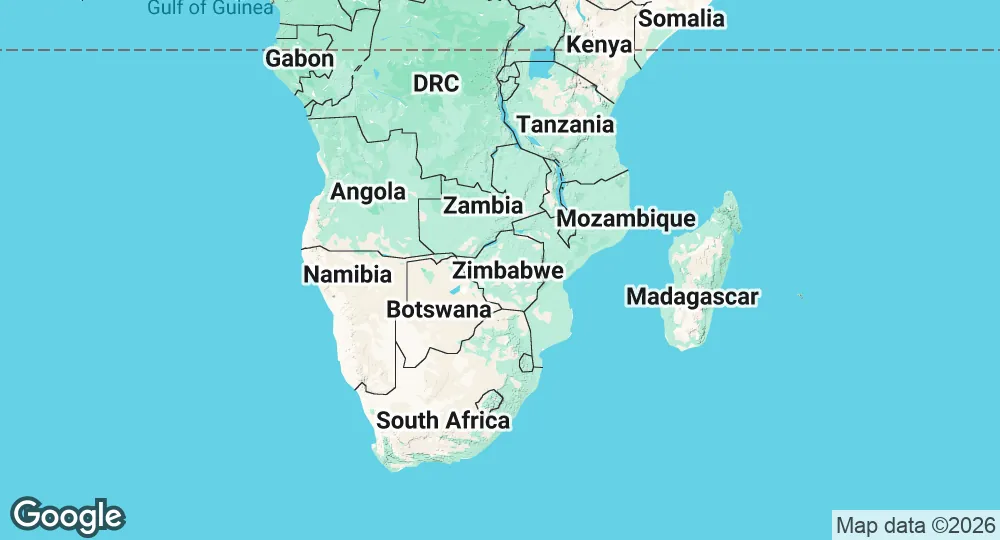
Zimbabwe is a landlocked state in Southern Africa, sharing borders with South Africa, Botswana, Zambia, and Mozambique. Its security environment is defined by membership in the Southern African Development Community (SADC) and the African Union (AU). The country is a signatory to the SADC Mutual Defence Pact, which mandates collective action in the event of an armed attack against a member state.
Primary security concerns involve border management, illegal migration, and regional stability. Relationships with neighboring states are generally stable, though tensions with Zambia emerged in 2025 regarding perceived increases in Western military influence in the region. Zimbabwe maintains long-term bilateral defense ties with China and Russia, which serve as its primary sources of hardware and technical training.
The country participates in regional peacekeeping and intervention operations. Zimbabwe contributed personnel and leadership to the SADC Mission in the Democratic Republic of Congo (SAMIDRC). In March 2025, SADC ordered a phased withdrawal of these forces following a summit chaired by the Zimbabwean presidency, shifting the regional focus toward diplomatic resolutions for the conflict in eastern DRC.
Military Forces
The Zimbabwe Defence Forces (ZDF) are composed of the Zimbabwe National Army (ZNA) and the Air Force of Zimbabwe (AFZ). The President serves as the Commander-in-Chief, with operational command exercised through the Minister of Defence and the Commander of the ZDF. Personnel strength is approximately 30,000 active members, with the ZNA accounting for the vast majority of the force.
Zimbabwe National Army
The ZNA is organized into several brigade-sized formations, including five infantry brigades, a mechanized brigade, an artillery brigade, and the Presidential Guard. Specialized units include the Parachute Regiment and the Commando Regiment.
The army operates a range of armored vehicles and artillery, primarily of Soviet and Chinese origin. Its inventory includes:
-
Main Battle Tanks: Type 59 and T-54/55 models.
-
Armored Vehicles: EE-9 Cascavel armored cars and various armored personnel carriers, including the BTR-60 and Type 63.
-
Recent Deliveries: In late 2024 and 2025, the ZNA integrated a consignment of Chinese-made WZ551 armored personnel carriers and WMA301 fire support vehicles.
-
Artillery: Type 54 and D-30 howitzers, supplemented by RM-70 multiple rocket launchers.
Air Force of Zimbabwe
The AFZ is headquartered at Manyame Air Base and Thornhill Air Base. It provides close air support, transport, and reconnaissance. The fleet includes:
-
Combat and Training Aircraft: Chengdu F-7 fighters and K-8 Karakorum jet trainers.
-
Helicopters: Mi-35 attack helicopters, alongside Mi-17 and Bell 412 utility models.
-
Modernization: In 2025, the AFZ sought to recapitalize its training capabilities through cooperation with Pakistan, specifically regarding the Super Mushshak trainer aircraft.
Defense Industry
The domestic arms sector is led by Zimbabwe Defence Industries (ZDI), a state-owned enterprise. ZDI focuses on the production of small arms ammunition (7.62mm and 9mm), mortars, and personal protective equipment.
The industry has faced prolonged operational challenges due to international sanctions and domestic economic volatility. In February 2025, the European Union delisted ZDI from its restrictive measures, although a broader arms embargo remains in place for equipment perceived as having utility for internal repression. The country relies heavily on imports and donations from China for heavy platforms and advanced electronics.
Strategic Trends
Defense policy is currently guided by the transition from the National Development Strategy 1 (NDS1) to NDS2 (2026–2030). The 2025 defense budget was approximately ZiG 18.05 billion, representing a fraction of the funding requested by the military leadership. This budgetary constraint has restricted the procurement of spare parts and the frequency of large-scale training exercises.
Current priorities include:
-
Equipment Maintenance: Efforts to refurbish aging airframes, such as the BAE Hawk, using alternative supply chains.
-
Infrastructure: Construction of schools, clinics, and social welfare projects by AFZ and ZNA engineering units, a program scheduled for expansion through 2026.
-
Technology Integration: A shift toward electronic surveillance and the use of unmanned aerial vehicles (UAVs) for border patrol and anti-poaching operations.
-
Cybersecurity: Development of specialized units to address unconventional threats and protect national communications infrastructure.
Force readiness remains hampered by high inflation and the resulting impact on personnel retention and morale. The military increasingly relies on resource-for-equipment swaps with external partners to bypass financial liquidity issues.
Military Expenditure: CIA World Factbook. Last updated on 25 September 2026. Suggest a change
Frequently Asked Questions
How large is Zimbabwe's military?
What is Zimbabwe's defense budget?
How does Zimbabwe rank militarily in the world?
Does Zimbabwe have nuclear weapons?
How many aircraft does Zimbabwe's air force have?
How many tanks does Zimbabwe have?
What percentage of GDP does Zimbabwe spend on defense?
What is Zimbabwe's military personnel per capita?
Does Zimbabwe have paramilitary forces?
- SEP 252026 Updated Population and GDP added for 2025; GDP series revised
- AUG 42026 Updated Global Military Index updated in a site-wide editorial pass
- JUL 162026 Updated Global Military Index updated in a site-wide editorial pass
- JUN 162026 Updated Yearly statistics, military spending and 2 more fields updated
- JAN 172026 Updated Main battle tank count and Global Military Index updated
- JAN 132026 Updated Description added