Uganda Military Forces
Uganda ranks #90 of 170 militaries worldwide in 2026, with 45,000 active troops. The Ugandan Army fields 674 ground vehicles, including 239 main battle tanks; the Air Force flies 51 aircraft, including 6 combat aircraft. Landlocked, Uganda has no navy and no nuclear weapons.
Armed Forces in 2026
| Domain | Strength | Composition |
|---|---|---|
| Uganda Air Force | 51 aircraft | 6 combat 29 helicopters +2 on order |
| Ground Forces | 674 vehicles | 239 main battle tanks |
| Personnel | 45,000 active | 10,000 reserve 1,400 paramilitary |
ATLAS Index (Aggregate Total of Land, Air and Sea strength)
Full ranking →| Pillar | Weight | Score | Basis |
|---|---|---|---|
| Manpower | 10% | 34.6 | Active, reserve & paramilitary personnel |
| Ground forces | 20% | 28.7 | ARMS inventory power: armour & artillery by type and era, attack helicopters, armament |
| Naval power | 20% | 0.0 | SEAS inventory power: hulls by type, size and era, air wing, sustainment, armament |
| Air power | 25% | 19.2 | AIRS inventory power: aircraft by type and generation, enablers, armament |
| Nuclear deterrent | 10% | 0.0 | No declared nuclear capability |
| Defense budget | 15% | 19.4 | Annual spending, purchasing-power adjusted |
| Availability | modifier | ground ×0.89 · naval ×1.00 · air ×1.00 | Budget per point of each force, from the branch indexes |
Country File
| Population | 51.4M (2025) |
| GDP | $62.0 billion (2025) |
| GDP per capita | $1,206 |
| Military budget | $1.3B (2025) |
| Share of GDP | 2.0% (2025) |
| Share of govt spending | 9.0% (2025) |
| Military spending per capita | $26 (2025) |
| Inflation rate | 3.58% (2025) |
| Capital | Kampala |
| Region | Africa |
| Land area | 197,100 km² |
| Land borders | 2,698 km |
| Bordering countries | 5 |
| Currency | UGX |
Strategic Overview in 2026
Strategic Position
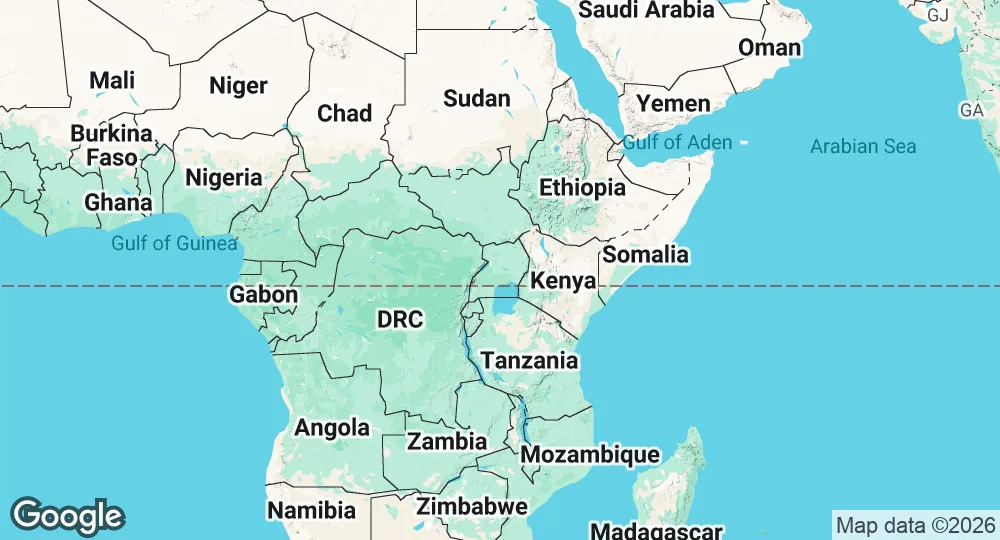
Uganda is a landlocked state in East Africa, positioned at the center of the Great Lakes region. Its defense posture is defined by internal security challenges, regional instability in the Democratic Republic of the Congo (DRC) and South Sudan, and its role as a primary contributor to African Union-led peace support operations.
The country is a member of the East African Community (EAC) and the Intergovernmental Authority on Development (IGAD). It participates in the EAC Regional Force and maintains bilateral security agreements with the DRC for joint operations against the Allied Democratic Forces (ADF), an insurgent group operating in the eastern DRC. Uganda’s military doctrine focuses on counter-insurgency, border security, and regional power projection through international peacekeeping mandates.
Relations with Rwanda have fluctuated between cooperation and tension, leading to periodic border closures and military build-ups, though diplomatic efforts through the EAC have aimed at normalization. In the north, the volatility of South Sudan necessitates a permanent military presence to manage refugee flows and prevent cross-border incursions by armed factions.
Military Forces
The Uganda People’s Defence Forces (UPDF) is the national military organization, overseen by the Ministry of Defence and Veteran Affairs. The President serves as the Commander-in-Chief. The UPDF is organized into the Land Forces, Air Force, and the Special Forces Command (SFC). The SFC is an independent unit responsible for the protection of the presidency and the security of strategic national assets, including oil fields.
The UPDF maintains an active personnel strength of approximately 45,000 to 50,000 troops, supplemented by a reserve force and local defense units.
Land Forces
The Land Forces constitute the bulk of the UPDF’s manpower. The inventory includes T-90S, T-72, and T-55 main battle tanks. For mobility and reconnaissance, the army operates BTR-60 and BTR-80 armored personnel carriers, BMP-2 infantry fighting vehicles, and various mine-resistant ambush-protected (MRAP) vehicles such as the Casspir and Mamba. Artillery capabilities consist of BM-21 Grad multiple rocket launchers and towed 122mm and 130mm howitzers.
Air Force
The Uganda People’s Defence Air Force (UPDAF) focuses on ground attack and transport capabilities to support land operations. Its primary combat aircraft are Su-30MK2 multirole fighters and MiG-21 interceptors. The rotary-wing fleet includes Mi-24/35 attack helicopters and Mi-17 transport helicopters. The UPDAF also maintains a small fleet of light transport and trainer aircraft, including Cessna 208 Caravans and L-39 Albatros jets.
Specialized Units
The Special Forces Command is the most modernized component of the UPDF, equipped with advanced small arms, night-vision equipment, and specialized communications gear. It often takes the lead in high-stakes counter-terrorism operations and foreign deployments.
Defense Industry
Uganda maintains a domestic defense manufacturing capability through the National Enterprise Corporation (NEC), the commercial arm of the UPDF. The primary facility, Luwero Industries, focuses on the production and repair of small arms, ammunition, and light armored vehicles.
Domestic production includes the assembly and refurbishment of armored personnel carriers and MRAPs, such as the Chui and Nyoka vehicles, which are based on foreign designs but adapted for local terrain. Uganda has established a helicopter maintenance, repair, and overhaul (MRO) facility, Pro-Heli International Services, in a joint venture with Russian partners to service its Mi-series fleet domestically. This infrastructure aims to reduce reliance on external supply chains for routine maintenance and basic ordnance.
Strategic Trends
The UPDF is currently engaged in a long-term modernization program focused on electronic warfare, unmanned aerial vehicles (UAVs), and intelligence-gathering capabilities. Defense spending remains high relative to regional peers, driven by the ongoing Operation Shujaa in the DRC and the transition from the African Union Transition Mission in Somalia (ATMIS) to the African Union Support and Stabilization Mission in Somalia (AUSSOM) in 2025.
A primary constraint facing the military is the reliance on aging Soviet-era hardware, which requires continuous upgrading to remain operationally viable. The UPDF is prioritizing the acquisition of UAVs for border surveillance and strike missions to counter the ADF’s use of dense forest cover in the DRC.
Future force structure shifts include the professionalization of the Reserve Force and the integration of cyber-defense units into the SFC to address emerging non-traditional security threats. The military also faces the challenge of managing internal security duties, as the UPDF is frequently deployed to support the Uganda Police Force in domestic stability operations.
Military Expenditure: information from the Stockholm International Peace Research Institute (SIPRI) Military Expenditure Database. Last updated on 25 September 2026. Suggest a change
Frequently Asked Questions
How large is Uganda's military?
What is Uganda's defense budget?
How does Uganda rank militarily in the world?
Does Uganda have nuclear weapons?
How many aircraft does Uganda's air force have?
How many tanks does Uganda have?
What percentage of GDP does Uganda spend on defense?
What is Uganda's military personnel per capita?
Does Uganda have paramilitary forces?
- SEP 252026 Updated Population, GDP and inflation added for 2025; GDP series revised
- AUG 102026 Updated Rank insignia and ranks overview added
- AUG 42026 Updated Global Military Index updated in a site-wide editorial pass
- AUG 32026 Updated Global Military Index updated
- JUL 162026 Updated Global Military Index updated in a site-wide editorial pass
- JUN 162026 Updated Yearly statistics, military spending and 2 more fields updated
- JAN 172026 Updated Main battle tank count and Global Military Index updated