Thailand Military Forces
Open-source order of battle for 2026: 360,850 active troops, 481 aircraft, 307 warships, 2,840 ground vehicles.
Armed Forces in 2026
| Domain | Strength | Composition |
|---|---|---|
| Royal Thai Air Force | 481 aircraft | 84 combat 247 helicopters 17 air bases +16 on order |
| Royal Thai Navy | 307 warships | 7 major combatants 1 carrier |
| Ground Forces | 2,840 vehicles | 445 main battle tanks |
| Personnel | 360,850 active | 200,000 reserve 138,700 paramilitary |
Global Military Index
Full ranking →| Pillar | Weight | Score | Basis |
|---|---|---|---|
| Manpower | 15% | 81.3 | Active, reserve & paramilitary personnel |
| Ground forces | 20% | 58.9 | Tanks, armor & artillery weighted by type |
| Naval power | 20% | 53.6 | Weighted by hull type: carrier tiers, nuclear vs conventional submarines |
| Air power | 25% | 52.2 | Weighted by aircraft type and fleet age |
| Nuclear deterrent | 10% | 0.0 | No declared nuclear capability |
| Defense budget | 10% | 55.0 | Annual spending, purchasing-power adjusted |
| Readiness | modifier | ×0.94 | Budget per soldier: proxy for training, maintenance & technology |
Country File
| Population | 71.7M (2024) |
| GDP | $526.5 billion (2024) |
| GDP per capita | $7,347 |
| Military budget | $5.8B (2024) |
| Share of GDP | 1.1% (2024) |
| Military spending per capita | $81 (2024) |
| Inflation rate | 1.37% (2024) |
| Capital | Bangkok |
| Region | Asia |
| Land area | 510,890 km² |
| Coastline | 3,219 km |
| Land borders | 4,863 km |
| Bordering countries | 4 |
| Currency | THB |
Strategic Overview in 2026
Strategic Position
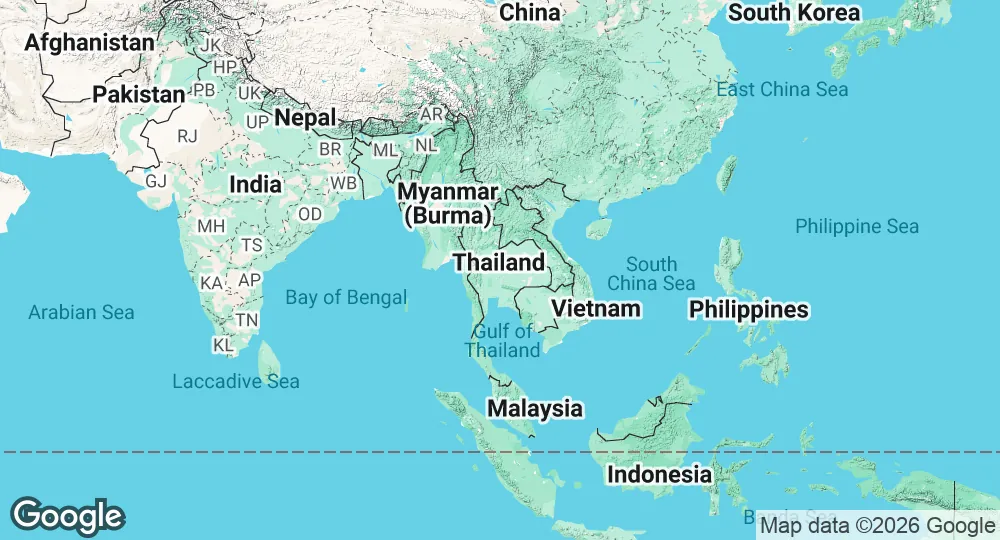
Thailand occupies a central position in mainland Southeast Asia, sharing land borders with Myanmar, Laos, Cambodia, and Malaysia. Its maritime boundaries extend into the Gulf of Thailand and the Andaman Sea. Primary security concerns involve border instability resulting from the ongoing civil conflict in Myanmar, maritime territorial disputes in the South China Sea, and a long-standing ethno-nationalist insurgency in the southern provinces of Yala, Pattani, and Narathiwat.
Thailand is a Major Non-NATO Ally of the United States, a designation established in 2003. This relationship is codified through the 1954 Manila Pact and the 1962 Thanat-Khoman Communiqué. The country hosts Cobra Gold, one of the largest annual multilateral military exercises in the Indo-Pacific. Simultaneously, Thailand maintains a policy of strategic hedging, expanding defense cooperation with China through joint exercises such as Falcon Strike and Blue Strike, as well as significant hardware acquisitions. As a member of ASEAN, Thailand participates in the ASEAN Defense Ministers' Meeting (ADMM) and emphasizes regional stability through multilateral diplomacy.
Defense doctrine prioritizes the protection of the monarchy, internal security, and the maintenance of territorial integrity against non-traditional threats, including narcotics trafficking and unregulated migration.
Military Forces
The Royal Thai Armed Forces (RTARF) are overseen by the Ministry of Defence, with the Royal Thai Armed Forces Headquarters serving as the joint command element. The King of Thailand is the titular Head of the Armed Forces. Personnel strength consists of approximately 350,000 active-duty members and a reserve force of approximately 200,000. Military service is conducted through a combination of voluntary enlistment and an annual lottery-based conscription system.
Royal Thai Army (RTA) The RTA is the dominant branch, structured into four regional Army Areas. It operates a diverse inventory of main battle tanks including the VT-4, T-84 Oplot-M, and M60A3. Infantry mobility is provided by Stryker armored personnel carriers, BTR-3E1 vehicles, and the domestically produced First Win MRAP. Field artillery includes M109A5 self-propelled howitzers and the DTI-1 multiple launch rocket system.
Royal Thai Navy (RTN) The RTN operates out of major bases at Sattahip and Songkhla. Its fleet includes the STOVL-capable carrier HTMS Chakri Naruebet, which currently functions as a helicopter platform and disaster relief vessel. Surface combatants consist of DW-3000F class frigates and Type 054A frigates. The navy maintains a Marine Corps and a specialized Air and Coastal Defense Command. Coastal surveillance is supported by various patrol craft and S-70B Seahawk helicopters.
Royal Thai Air Force (RTAF) The RTAF is organized into several wings distributed across the country. The primary combat fleet comprises F-16A/B Fighting Falcons and JAS 39 C/D Gripens. Lead-in fighter training is conducted with T-50TH Golden Eagle aircraft. Airborne Early Warning and Control (AEW&C) is provided by the Saab 340 Erieye system. The transport fleet includes C-130H Hercules aircraft.
Specialized Capabilities The Royal Thai Army Special Warfare Command oversees elite units including the 1st Special Forces Division. The navy maintains the Naval Special Warfare Command, modeled after the U.S. Navy SEALs. Cyber defense is managed through the Military Cyber Center, which focuses on protecting critical infrastructure and monitoring digital threats to national security.
Defense Industry
Thailand's defense industry is centered on the Defense Technology Institute (DTI), a public organization under the Ministry of Defence that manages research and development. The domestic industry emphasizes the production of armored vehicles, unmanned aerial vehicles (UAVs), and naval vessels.
Notable domestic products include the First Win 4x4 mine-resistant ambush protected (MRAP) vehicle and the Black Widow Spider 8x8 armored vehicle, produced by Chaiseri and Panus Assembly respectively. In the naval sector, Marsun Public Company Limited constructs patrol boats and fast attack craft for the RTN and export markets. Thailand has increasingly sought technology transfer agreements to support co-production, recently collaborating with international firms from Israel, China, and Turkey for the assembly of rocket systems and tactical drones.
Strategic Trends
The Royal Thai Armed Forces are currently engaged in a long-term modernization program focused on replacing Vietnam-era equipment. Procurement priorities include the acquisition of new multi-role fighter aircraft to replace aging F-16 variants and the expansion of the frigate fleet. A significant project involves the procurement of S26T Yuan-class submarines from China, though the program has faced technical delays regarding engine specifications.
Defense spending typically fluctuates between 1.3% and 1.5% of GDP. Recent budget cycles have emphasized "Point-Defense" capabilities and the integration of network-centric warfare technologies. The military faces constraints including budgetary transparency concerns and the logistical challenge of maintaining a "mixed" inventory of American, European, Russian, and Chinese hardware. There is an ongoing institutional shift toward professionalizing the force, including proposals to reduce the number of general officers and transition toward a fully voluntary recruitment model by 2030.
Thai Defense Manufacturing
Designed in ThailandFrequently Asked Questions
How large is Thailand's military?
What is Thailand's defense budget?
How does Thailand rank militarily in the world?
Does Thailand have nuclear weapons?
How many aircraft does Thailand's air force have?
How large is Thailand's navy?
How many tanks does Thailand have?
What percentage of GDP does Thailand spend on defense?
What is Thailand's military personnel per capita?
Does Thailand have aircraft carriers?
Does Thailand have paramilitary forces?
Military Expenditure: CIA World Factbook. Last updated on 4 August 2026. Suggest a change
- AUG 42026 Updated Global Military Index updated in a site-wide editorial pass
- AUG 32026 Updated Global Military Index updated
- JUL 242026 Updated Global Military Index updated
- JUL 162026 Updated Global Military Index updated in a site-wide editorial pass
- JUL 12026 Updated Rank insignia and ranks overview updated
- JUN 162026 Updated Yearly statistics, military spending and 2 more fields updated
- JAN 172026 Updated Main battle tank count and Global Military Index updated