Namibia Military Forces
Namibia ranks #121 of 169 militaries worldwide in 2026, with 9,900 active troops. The Namibian Army fields 4 main battle tanks; the Air Force flies 35 aircraft, including 22 combat aircraft. Namibia has no nuclear weapons.
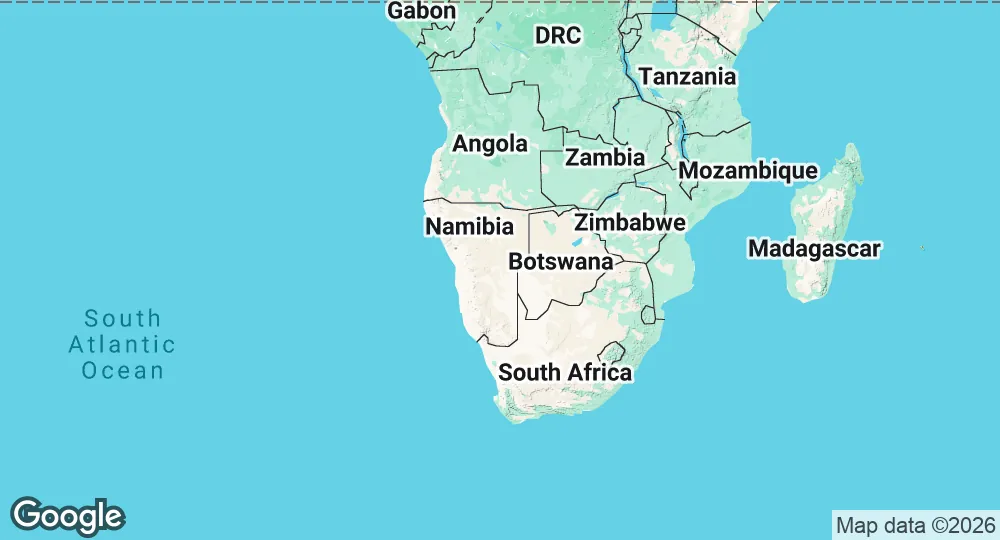
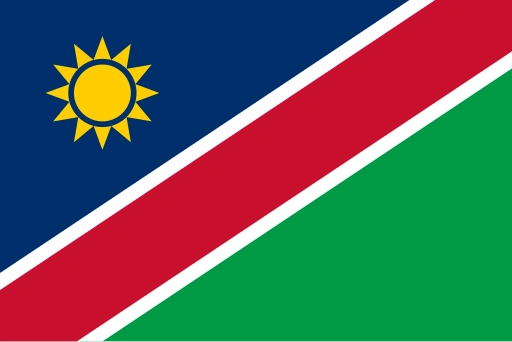
Armed Forces in 2026
| Domain | Strength | Composition |
|---|---|---|
| Air Force | 35 aircraft | 22 combat 8 helicopters |
| Ground Forces | 4 tanks | |
| Personnel | 9,900 active | 6,000 paramilitary |
ATLAS Index (Aggregate Total of Land, Air and Sea strength)
Full ranking →| Pillar | Weight | Score | Basis |
|---|---|---|---|
| Manpower | 10% | 23.9 | Active, reserve & paramilitary personnel |
| Ground forces | 20% | 13.0 | ARMS inventory power: armour & artillery by type and era, attack helicopters, armament |
| Naval power | 20% | 0.0 | SEAS inventory power: hulls by type, size and era, air wing, sustainment, armament |
| Air power | 25% | 15.7 | AIRS inventory power: aircraft by type and generation, enablers, armament |
| Nuclear deterrent | 10% | 0.0 | No declared nuclear capability |
| Defense budget | 15% | 14.2 | Annual spending, purchasing-power adjusted |
| Availability | modifier | ground ×0.88 · naval ×1.00 · air ×0.93 | Budget per point of each force, from the branch indexes |
Country File
| Population | 3.1M (2025) |
| GDP | $15.1 billion (2025) |
| GDP per capita | $4,876 |
| Military budget | $374M (2024) |
| Share of GDP | 2.8% (2024) |
| Military spending per capita | $121 (2024) |
| Inflation rate | 3.51% (2025) |
| Capital | Windhoek |
| Region | Africa |
| Land area | 823,290 km² |
| Coastline | 1,572 km |
| Land borders | 3,936 km |
| Bordering countries | 4 |
| Currency | NAD |
Strategic Overview in 2026
Strategic Position
Namibia maintains a defense policy centered on regional stability and non-alignment. As a member of the Southern African Development Community (SADC) and the African Union (AU), the state participates in the SADC Standby Force and the SADC Mission in Mozambique (SAMIM). Primary security concerns involve maritime domain awareness along the 1,572-kilometer Atlantic coastline, cross-border smuggling, and the protection of exclusive economic zones (EEZ) against illegal, unreported, and unregulated (IUU) fishing.
The national defense doctrine is defensive in nature, prioritizing sovereignty and territorial integrity. Namibia maintains cooperative security relationships with neighboring South Africa, Angola, Botswana, and Zambia. Military cooperation with China and Russia remains a component of the defense posture, involving equipment procurement and technical training. Furthermore, Namibia maintains a long-standing bilateral maritime agreement with Brazil, which provides training and support for the development of the Namibian Navy.
Military Forces
The Namibian Defence Force (NDF) is a unified structure under the Ministry of Defence and Veterans Affairs. The President serves as the Commander-in-Chief, with operational control vested in the Chief of the Defence Force. The NDF comprises three primary branches: the Army, Air Force, and Navy. Total active personnel strength is approximately 15,000, supported by a reserve force and the Namibian Police Force (NamPol) for internal security.
Army The Army is the largest branch, structured into infantry brigades, an artillery brigade, and specialized engineer and signal regiments. Its inventory of armored fighting vehicles includes T-54/55 and T-72 main battle tanks. For troop transport and reconnaissance, the Army utilizes BTR-60 and WZ-523 wheeled armored personnel carriers, alongside South African-designed Ratel infantry fighting vehicles and Casspir mine-protected vehicles. Artillery capabilities consist of Grad multiple rocket launchers, D-30 towed howitzers, and various mortar systems.
Air Force Operating primarily from Karibib Air Force Base and Grootfontein Air Force Base, the Air Force provides air defense, transport, and reconnaissance. The combat fleet consists of Chengdu F-7 fighter-interceptors and Hongdu K-8 jet trainers. Transport requirements are met by Antonov An-26 and Harbin Y-12 aircraft. The rotary-wing component operates Mil Mi-8 and Mi-17 transport helicopters, supplemented by Mil Mi-24 attack helicopters and Aérospatiale Alouette III utility units.
Navy Headquartered at Walvis Bay, the Navy focuses on coastal defense and fisheries protection. The fleet includes the S11 (NS Elephant) logistics and patrol vessel, alongside Graça Machel-class and Brendan Simbwaye-class corvettes. The force also maintains a fleet of small patrol craft and interceptors for littoral operations. A Marine Corps unit exists for amphibious operations and installations security, receiving specialized training from Brazilian naval instructors.
Defense Industry
The domestic defense industry is managed primarily through August 26 Holdings, a state-owned conglomerate under the Ministry of Defence. Its subsidiary, Windhoeker Maschinenfabrik (WMF), manufactures armored vehicles and provides maintenance, repair, and overhaul (MRO) services. Notable products include the Werewolf MKII and Wolf series of mine-protected vehicles, which are utilized by the NDF and exported to regional partners for peacekeeping operations.
Despite these domestic capabilities, Namibia remains reliant on foreign imports for advanced systems. China is a major supplier of radar, missile systems, and small arms. Maintenance of the aviation fleet is frequently conducted through technical agreements with original equipment manufacturers in Russia and China.
Strategic Trends
Defense spending in Namibia has stabilized at approximately 3% of GDP. Procurement priorities focus on the modernization of the Army’s aging Soviet-era vehicle fleet and the enhancement of maritime surveillance technology. The NDF is increasingly integrating unmanned aerial vehicles (UAVs) for border monitoring and anti-poaching operations.
Operational focus is shifting toward asymmetric threats, including maritime piracy and cyber security. The NDF has established dedicated units to address electronic warfare and information security. Participation in regional security frameworks remains a priority, with NDF personnel frequently deployed to SADC-led initiatives to combat insurgency in Southern Africa. Constraints on the military include a reliance on external suppliers for electronic components and a need for improved infrastructure at northern border outposts.
Military Expenditure: CIA World Factbook. Last updated on 25 September 2026. Suggest a change
Frequently Asked Questions
How large is Namibia's military?
What is Namibia's defense budget?
How does Namibia rank militarily in the world?
Does Namibia have nuclear weapons?
How many aircraft does Namibia's air force have?
How many tanks does Namibia have?
What percentage of GDP does Namibia spend on defense?
What is Namibia's military personnel per capita?
Does Namibia have paramilitary forces?
- SEP 252026 Updated Population, GDP and inflation added for 2025; GDP series revised
- AUG 42026 Updated Global Military Index updated in a site-wide editorial pass
- JUL 162026 Updated Global Military Index updated in a site-wide editorial pass
- JUN 162026 Updated Yearly statistics, military spending and 2 more fields updated
- JAN 172026 Updated Main battle tank count and Global Military Index updated
- JAN 132026 Updated Description added