Lebanon Military Forces
Open-source order of battle for 2026: 60,000 active troops, 64 aircraft, 48 warships.
Armed Forces in 2026
| Domain | Strength | Composition |
|---|---|---|
| Air Force | 64 aircraft | 47 helicopters 3 air bases |
| Lebanese Navy | 48 warships | |
| Ground Forces | 116 tanks | |
| Personnel | 60,000 active | 24,500 paramilitary |
ARMS Index (Aggregate Rating of Military Strength)
Full ranking →| Pillar | Weight | Score | Basis |
|---|---|---|---|
| Manpower | 15% | 62.3 | Active, reserve & paramilitary personnel |
| Ground forces | 20% | 47.3 | Tanks, armor & artillery weighted by type |
| Naval power | 20% | 18.5 | Weighted by hull type: carrier tiers, nuclear vs conventional submarines |
| Air power | 25% | 24.1 | Weighted by aircraft type and fleet age |
| Nuclear deterrent | 10% | 0.0 | No declared nuclear capability |
| Defense budget | 10% | 31.9 | Annual spending, purchasing-power adjusted |
| Readiness | modifier | ×0.93 | Budget per soldier: proxy for training, maintenance & technology |
Country File
| Population | 5.8M (2024) |
| GDP | $20.1 billion (2023) |
| GDP per capita | $3,458 |
| Military budget | $828M (2025) |
| Share of GDP | 2.5% (2025) |
| Share of govt spending | 16.6% (2025) |
| Military spending per capita | $142 (2025) |
| Inflation rate | 45.24% (2024) |
| Capital | Beirut |
| Region | Asia |
| Land area | 10,230 km² |
| Coastline | 225 km |
| Land borders | 454 km |
| Bordering countries | 2 |
| Currency | LBP |
Strategic Overview in 2026
Strategic Position
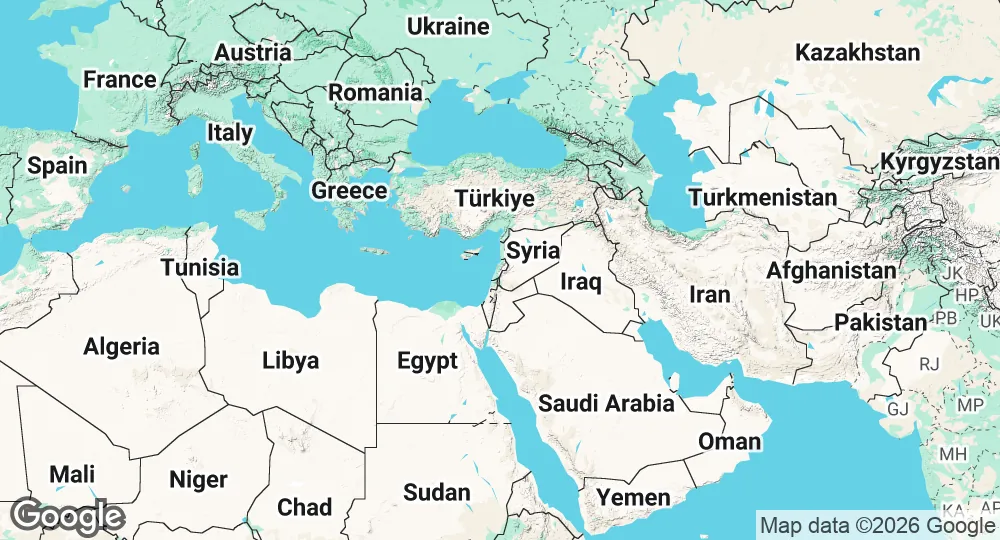
Lebanon occupies a volatile geopolitical position between Israel to the south and Syria to the north and east. Following the conclusion of a major conflict between Israel and Hezbollah in late 2024, the Lebanese Armed Forces (LAF) have assumed a central role in implementing United Nations Security Council Resolution 1701 and reasserting state sovereignty over southern Lebanon. The political landscape shifted in January 2025 with the election of former LAF Commander Joseph Aoun as President and the subsequent appointment of Nawaf Salam as Prime Minister. These developments, alongside the collapse of the Assad administration in Syria in December 2024, have significantly altered Lebanon's security environment, reducing the traditional influence of regional non-state actors and their external sponsors.
Lebanon does not maintain formal memberships in major military alliances such as NATO. Instead, its defense posture relies on bilateral security assistance and international peacekeeping frameworks. The United States remains the primary benefactor, providing substantial Foreign Military Financing (FMF) and material aid. France and the United Kingdom also provide specialized training and equipment, particularly for border security and mountain warfare. The United Nations Interim Force in Lebanon (UNIFIL) operates in the south, though its mandate is currently slated for conclusion in December 2026, placing increasing pressure on the LAF to achieve self-sufficiency in border control and maritime security.
The primary strategic priority is the establishment of a state monopoly on the use of force. Under a five-phase roadmap approved in late 2025, the government has tasked the military with disarming non-state groups, including Hezbollah and various Palestinian factions within refugee camps. This internal security focus is balanced against the necessity of maintaining a credible deterrent against Israeli incursions, which have continued despite the 2024 ceasefire.
Military Forces
The Lebanese Armed Forces (LAF) comprise approximately 80,000 active-duty personnel and 15,000 reserves. The force is structured into three primary branches: the Ground Forces (Army), the Air Force, and the Navy, with the Ground Forces acting as the dominant component. Following the ascension of Joseph Aoun to the presidency in 2025, General Rodolphe Haykal assumed command of the military.
Ground Forces
The Army is organized into territorial brigades, intervention regiments, and specialized units. Its primary inventory consists of Western and Soviet-era platforms.
-
Armor: Operates M60A3 and T-54/55 main battle tanks.
-
Mechanized Infantry: Maintains a large fleet of M113 armored personnel carriers and VAB wheeled armored vehicles.
-
Artillery: Utilizes M109 self-propelled howitzers and M198 towed howitzers.
-
Specialized Units: Elite capabilities reside in the Commando Regiment (Maghaweer), the Rangers (Moukafaha), and the Airborne Regiment. These units are frequently deployed for counter-terrorism and high-stakes disarmament operations.
Air Force
The Lebanese Air Force is configured for light attack, reconnaissance, and transport rather than air superiority.
-
Fixed-Wing: Operates A-29 Super Tucano light attack aircraft and AC-208 Combat Caravan platforms for precision strikes and surveillance.
-
Rotary-Wing: The fleet centers on UH-1H Huey II and SA342 Gazelle helicopters, used for transport and close air support.
Navy
The Navy is a coastal defense force tasked with patrolling Lebanon's Exclusive Economic Zone (EEZ) and preventing maritime smuggling. It operates a fleet of coastal patrol craft and landing craft, largely donated by the United States and European partners.
Strategic Trends
The Lebanese military is currently navigating a transition from a domestic stabilization force to a primary border defense organization. The "five-phase roadmap" initiated in late 2025 serves as the operational blueprint for this shift, prioritizing the dismantling of unauthorized military infrastructure south of the Litani River. The first phase of this deployment was completed in early 2026, asserting state control over former conflict zones.
Defense spending remains constrained by Lebanon's ongoing economic recovery. The 2026 budget reflects a continued reliance on international financial support to meet operational costs and personnel salaries. In 2025, the United States approved multiple aid packages, including $95 million in FMF and $14.2 million through the Presidential Drawdown Authority specifically for disarmament activities.
Procurement priorities are centered on "Livelihood Support" for personnel, maintenance of existing platforms, and the acquisition of demolition and detection equipment for clearing unexploded ordnance and tunnels. Future force structure shifts will likely emphasize expanded surveillance capabilities along the Syrian border and the reinforcement of naval assets to protect offshore energy interests, assuming the 2026 UNIFIL withdrawal proceeds as planned.
Military Expenditure: information from the Stockholm International Peace Research Institute (SIPRI) Military Expenditure Database. Last updated on 11 August 2026. Suggest a change
Frequently Asked Questions
How large is Lebanon's military?
What is Lebanon's defense budget?
How does Lebanon rank militarily in the world?
Does Lebanon have nuclear weapons?
How many aircraft does Lebanon's air force have?
How large is Lebanon's navy?
How many tanks does Lebanon have?
What percentage of GDP does Lebanon spend on defense?
What is Lebanon's military personnel per capita?
Does Lebanon have paramilitary forces?
- AUG 112026 Updated Global Military Index updated
- AUG 42026 Updated Global Military Index updated in a site-wide editorial pass
- AUG 32026 Updated Global Military Index updated
- JUL 162026 Updated Global Military Index updated in a site-wide editorial pass
- JUN 162026 Updated Yearly statistics, military spending and 2 more fields updated
- APR 82026 Updated Paramilitary personnel updated
- JAN 172026 Updated Main battle tank count and Global Military Index updated