Cuba Military Forces
Cuba ranks #65 of 170 militaries worldwide in 2026, with 49,000 active troops. The Cuban Army fields 4,636 ground vehicles, including 113 main battle tanks; the Air Force flies 20 aircraft; the Navy operates 33 warships. Cuba has no nuclear weapons.
Armed Forces in 2026
| Domain | Strength | Composition |
|---|---|---|
| Cuban Revolutionary Air Force | 20 aircraft | 13 helicopters 2 air bases |
| Cuban Revolutionary Navy | 33 warships | 2 major combatants |
| Ground Forces | 4,636 vehicles | 113 main battle tanks |
| Personnel | 49,000 active | 39,000 reserve 1,146,500 paramilitary |
ATLAS Index (Aggregate Total of Land, Air and Sea strength)
Full ranking →| Pillar | Weight | Score | Basis |
|---|---|---|---|
| Manpower | 10% | 56.9 | Active, reserve & paramilitary personnel |
| Ground forces | 20% | 40.8 | ARMS inventory power: armour & artillery by type and era, attack helicopters, armament |
| Naval power | 20% | 25.5 | SEAS inventory power: hulls by type, size and era, air wing, sustainment, armament |
| Air power | 25% | 13.0 | AIRS inventory power: aircraft by type and generation, enablers, armament |
| Nuclear deterrent | 10% | 0.0 | No declared nuclear capability |
| Defense budget | 15% | 10.9 | Annual spending, purchasing-power adjusted |
| Availability | modifier | ground ×0.80 · naval ×0.80 · air ×0.88 | Budget per point of each force, from the branch indexes |
Country File
| Population | 11M (2024) |
| GDP | $107.4 billion (2020) |
| GDP per capita | $9,777 |
| Military budget | $129M (2018) |
| Share of GDP | 2.9% (2018) |
| Military spending per capita | $11 (2018) |
| Capital | Havana |
| Region | America |
| Land area | 109,884 km² |
| Coastline | 3,735 km |
| Currency | CUP |
Strategic Overview in 2026
Strategic Position
Cuba’s defense posture is defined by its proximity to the United States and a doctrine of asymmetric resistance necessitated by substantial conventional disparities. The primary security concern remains a potential large-scale military intervention or surgical strike by U.S. forces, a concern intensified following the January 2026 U.S. special operations raid in Venezuela (Operation Absolute Resolve) that captured Nicolás Maduro. This event led the Cuban government to elevate its alert status and intensify its rhetoric regarding territorial sovereignty.
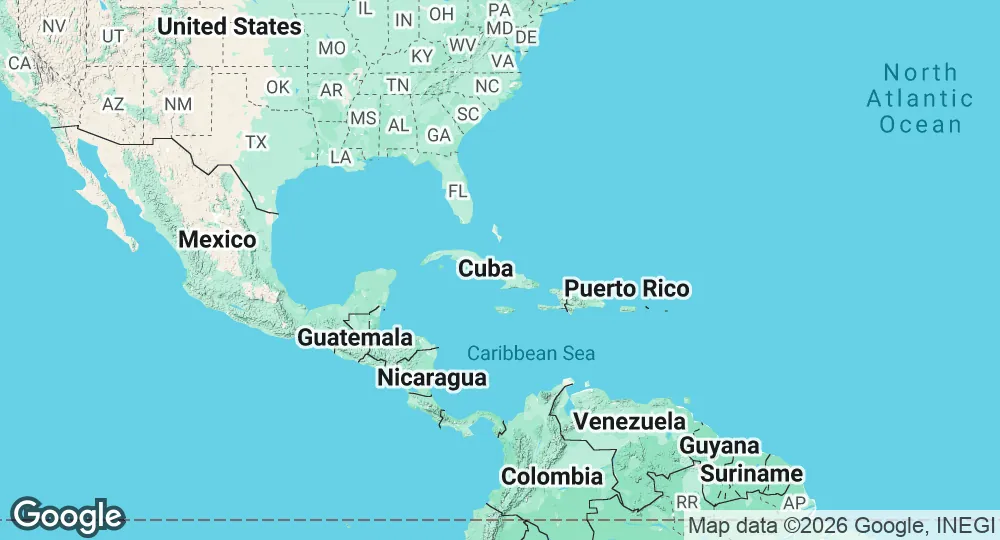
Defense doctrine centers on the "War of All the People" (Guerra de Todo el Pueblo). This strategy prioritizes a prolonged, decentralized resistance involving the entire population to make the cost of occupation unsustainable for an adversary. Strategically, Cuba serves as a maritime sentinel at the entrance to the Gulf of Mexico, commanding the Yucatan Channel and the Windward Passage.
Cuba maintains deep bilateral military and intelligence ties with Russia and China to counter regional isolation. In October 2025, Russia ratified an intergovernmental agreement on military cooperation with Cuba, providing a legal framework for expanded defense collaboration and potential deployments. Intelligence reports frequently note the presence of Chinese-backed signals intelligence (SIGINT) facilities on the island, used for surveillance of the southeastern United States. Regionally, Cuba remains a core member of the Bolivarian Alliance for the Peoples of Our America (ALBA), though the capture of Maduro in 2026 disrupted its primary regional security axis.
Military Forces
The Revolutionary Armed Forces (Fuerzas Armadas Revolucionarias – FAR) are organized into the Revolutionary Army, the Air and Air Defense Force (DAAFAR), and the Revolutionary Navy (MGR). The Ministry of the Interior (MININT) controls specialized internal security and border units.
-
Personnel: Active-duty strength is approximately 50,000. However, the core of the defense model is the paramilitary and reserve structure. The Militia of Territorial Troops (MTT) and the Production and Defense Brigades (BPD) comprise over 1.1 million personnel.
-
Revolutionary Army: Operates T-62 and T-55 main battle tanks, many of which have undergone domestic upgrades to integrate newer optics or secondary armament. Mechanized units utilize BMP-1 infantry fighting vehicles and BTR-60/70/80 armored personnel carriers. Towed artillery includes Soviet-era D-30 and M-46 pieces, supplemented by BM-21 Grad multiple rocket launchers.
-
Air and Air Defense Force (DAAFAR): Primarily a ceremonial and ground-based defense force due to severe fuel and spare parts shortages. The fighter inventory consists of MiG-29, MiG-23, and MiG-21 aircraft, though operational readiness is low. Air defense is the priority branch; in May 2025, Cuba completed the modernization of its S-125 Pechora surface-to-air missile systems to the Pechora-2BM standard with Belarusian assistance. These units are frequently mounted on T-55 tank chassis for improved mobility.
-
Revolutionary Navy (MGR): A littoral defense force focusing on coastal denial. It operates the Delfín-class midget submarine and a small number of Pauk II-class corvettes. Notable assets include the BP-390 and BP-391, which are converted large fishing vessels modified to serve as helicopter-capable patrol ships. Coastal defense is supported by the Frontera and Bandera missile systems.
-
Special Forces: The Avispas Negras (Black Wasps) are the elite special operations unit of the FAR, trained for jungle warfare, infiltration, and asymmetric urban operations.
Defense Industry
The state-owned Unión de Industrias Militares (UIM) manages the domestic defense sector through approximately 230 factories and companies. While Cuba relies on foreign partners like Belarus and Russia for electronics and high-tech components, the UIM has achieved a degree of self-sufficiency in maintenance and small arms production.
The UIM focuses on the life-extension of Soviet-era hardware. Notable projects include the conversion of towed artillery into self-propelled units and the mounting of anti-aircraft missiles on mobile tank platforms. Domestic infantry equipment includes the Mambí anti-materiel rifle and the Alejandro sniper rifle. Since 2025, the UIM has increasingly diverted resources toward the civilian economy, producing hygiene products and furniture to offset the military’s operational costs amidst national economic instability.
Strategic Trends
The Cuban military faces a period of structural fragility driven by a terminal energy crisis and the collapse of traditional lifelines from Venezuela. National power grid failures in 2025 severely hampered the training cycles and readiness of conventional units.
Procurement and modernization priorities are currently restricted to "asymmetric" capabilities. This includes the hardening of tunnel networks and underground command centers to withstand precision airstrikes. There is a visible shift toward prioritizing cyber and electronic warfare, often in coordination with Russian and Chinese technical advisors. Force structure remains static, but the frequency of "National Defense Days" increased in early 2026 to ensure the mobilization readiness of the civilian militias. The primary constraint facing the military is a lack of sustained fuel supplies, which has effectively grounded the air force and restricted army maneuvers to battalion-level exercises or smaller.
Military Expenditure: information from the Stockholm International Peace Research Institute (SIPRI) Military Expenditure Database. Last updated on 4 August 2026. Suggest a change
Frequently Asked Questions
How large is Cuba's military?
What is Cuba's defense budget?
How does Cuba rank militarily in the world?
Does Cuba have nuclear weapons?
How many aircraft does Cuba's air force have?
How large is Cuba's navy?
How many tanks does Cuba have?
What percentage of GDP does Cuba spend on defense?
What is Cuba's military personnel per capita?
Does Cuba have paramilitary forces?
- AUG 42026 Updated Global Military Index updated in a site-wide editorial pass
- JUL 242026 Updated Global Military Index updated
- JUL 162026 Updated Global Military Index updated in a site-wide editorial pass
- JUN 162026 Updated Yearly statistics and Global Military Index updated
- JAN 172026 Updated Main battle tank count and Global Military Index updated
- JAN 132026 Updated Description updated
- JUN 212025 Updated Country data reviewed and updated