Brunei Military Forces
Brunei ranks #141 of 170 militaries worldwide in 2026, with 7,200 active troops. The Air Force flies 26 aircraft. Brunei has no nuclear weapons.
Armed Forces in 2026
| Domain | Strength | Composition |
|---|---|---|
| Royal Brunei Air Force | 26 aircraft | 19 helicopters +8 on order |
| Personnel | 7,200 active | 700 reserve 500 paramilitary |
ATLAS Index (Aggregate Total of Land, Air and Sea strength)
Full ranking →| Pillar | Weight | Score | Basis |
|---|---|---|---|
| Manpower | 10% | 21.9 | Active, reserve & paramilitary personnel |
| Ground forces | 20% | 0.0 | ARMS inventory power: armour & artillery by type and era, attack helicopters, armament |
| Naval power | 20% | 0.0 | SEAS inventory power: hulls by type, size and era, air wing, sustainment, armament |
| Air power | 25% | 13.9 | AIRS inventory power: aircraft by type and generation, enablers, armament |
| Nuclear deterrent | 10% | 0.0 | No declared nuclear capability |
| Defense budget | 15% | 15.7 | Annual spending, purchasing-power adjusted |
| Availability | modifier | ground ×0.95 · naval ×1.00 · air ×1.09 | Budget per point of each force, from the branch indexes |
Country File
| Population | 462K (2024) |
| GDP | $15.3 billion (2024) |
| GDP per capita | $33,153 |
| Military budget | $560M (2024) |
| Share of GDP | 3.7% (2024) |
| Share of govt spending | 12.2% (2024) |
| Military spending per capita | $1,216 (2024) |
| Inflation rate | -0.39% (2024) |
| Capital | Bandar Seri Begawan |
| Region | Asia |
| Land area | 5,265 km² |
| Coastline | 161 km |
| Land borders | 381 km |
| Bordering countries | 1 |
| Currency | BND |
Strategic Overview in 2026
Strategic Position
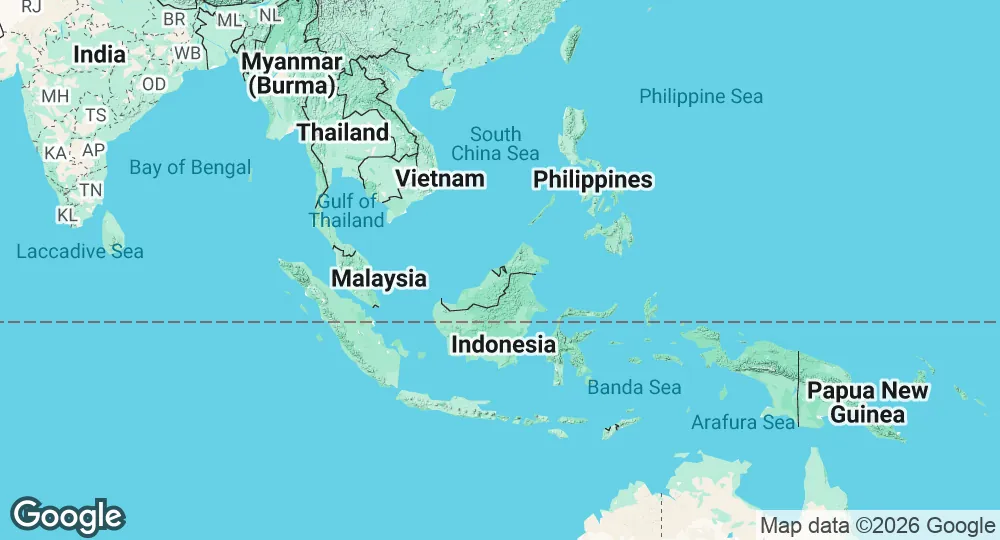
Brunei Darussalam occupies a geographically constrained but resource-rich position on the northern coast of the island of Borneo, overlooking the South China Sea. Its primary security concerns revolve around the protection of its Exclusive Economic Zone (EEZ) and maritime energy infrastructure, which are vital to the national economy. Brunei maintains a 200-nautical-mile EEZ claim that includes maritime features such as Louisa Reef, Owen Shoal, and Rifleman Bank. Unlike other claimants in the South China Sea, Brunei does not maintain a permanent military presence on these disputed features and is frequently characterized as a "silent claimant," prioritizing diplomatic resolution through the Association of Southeast Asian Nations (ASEAN) and adherence to the United Nations Convention on the Law of the Sea (UNCLOS).
Defense doctrine is centered on a "dual-track" approach that combines domestic deterrence with deep bilateral and multilateral security partnerships. A cornerstone of this strategy is the unique relationship with the United Kingdom; the UK-Brunei Garrison Agreement, renewed in December 2024, secures the permanent presence of a British Army battalion—the Royal Gurkha Rifles—in Seria. Brunei also maintains an exceptionally close defense relationship with Singapore, marked by the 50th anniversary of formal defense ties in January 2026. This relationship includes the permanent stationing of Singapore Armed Forces personnel at Lakiun Camp in Temburong for jungle warfare training and frequent bilateral exercises such as Exercise Maju Bersama. While maintaining these Western and regional ties, Brunei also balances an increasing economic and infrastructure partnership with China, which influences its non-confrontational maritime posture.
Military Forces
The Royal Brunei Armed Forces (RBAF) is an all-volunteer force consisting of approximately 7,000 to 9,000 active-duty personnel. Recruitment is restricted to Bruneian citizens of Malay descent. The Supreme Commander of the RBAF is the Sultan, who also serves as the Minister of Defense. The structure comprises three primary service branches: the Royal Brunei Land Force (RBLF), the Royal Brunei Navy (RBN), and the Royal Brunei Air Force (RBAirF).
The Royal Brunei Land Force operates as a light infantry-centric force structured into several battalions. Its armored capability is limited to light armored reconnaissance vehicles, including FV101 Scorpion light tanks and VAB 4x4 armored personnel carriers. The RBLF focuses on internal security, border protection, and jungle warfare, supported by a specialized Special Forces Regiment.
The Royal Brunei Navy is tasked with maritime domain awareness and protecting offshore oil and gas assets. Its primary surface combatants are the Darussalam-class offshore patrol vessels, which are equipped with anti-ship missiles. These are supported by Ijtihad-class and Mustaed-class fast patrol boats. The navy has prioritized the development of underwater threat detection and coastal surveillance capabilities to monitor its maritime borders.
The Royal Brunei Air Force provides transport, surveillance, and rotary-wing support. The backbone of its rotary fleet is the S-70i Black Hawk, used for troop transport and search and rescue. In the 2025-2026 period, the RBAirF has focused on integrating its new fleet of Airbus C295MW tactical transport aircraft, which replaced aging platforms to improve strategic airlift and maritime patrol range. The air force also operates CN235 transport aircraft and is incorporating H145M helicopters for light utility and training roles.
Strategic Trends
Defense spending in Brunei has seen a substantial upward trend, with the 2024/2025 and 2025/2026 budget cycles reflecting a prioritization of military modernization despite global economic volatility. Military expenditure is maintained at approximately 3% of GDP. These increases are directed toward enhancing Intelligence, Surveillance, Target Acquisition, and Reconnaissance (ISTAR) capabilities and modernizing infrastructure.
Procurement priorities are shifting toward unmanned systems and advanced maritime surveillance technologies to compensate for the military's limited personnel numbers. The RBAF is actively integrating Unmanned Aerial Systems (UAS) into its coastal and border patrol operations. Additionally, the military has established a Defense Capability Committee to oversee long-term asset management and ensure that new acquisitions, such as medium-range air defense systems and enhanced maritime patrol platforms, align with the 2021 Defense White Paper goals.
The primary constraint facing the RBAF is its limited manpower pool, which restricts the expansion of its force structure. Consequently, the military relies heavily on technological multipliers and the continued presence of foreign forces—specifically British and Singaporean units—to maintain a credible deterrent posture. Future force shifts are expected to emphasize cyber defense and the development of a more integrated joint command structure to improve interoperability during regional disaster response and maritime security operations.
Military Expenditure: information from the Stockholm International Peace Research Institute (SIPRI) Military Expenditure Database. Last updated on 4 August 2026. Suggest a change
Frequently Asked Questions
How large is Brunei's military?
What is Brunei's defense budget?
How does Brunei rank militarily in the world?
Does Brunei have nuclear weapons?
How many aircraft does Brunei's air force have?
What percentage of GDP does Brunei spend on defense?
What is Brunei's military personnel per capita?
Does Brunei have paramilitary forces?
- AUG 42026 Updated Global Military Index updated in a site-wide editorial pass
- AUG 32026 Updated Global Military Index updated
- JUL 162026 Updated Global Military Index updated in a site-wide editorial pass
- JUN 162026 Updated Yearly statistics, military spending and 2 more fields updated
- APR 82026 Updated Paramilitary personnel updated
- JAN 132026 Updated Description updated