EMB 120 Brasilia
Brazilian regional airliner, developed during the 1980s, known for its service with airlines for short-haul flights and military deployments. Key figures: top speed 608 km/h, range 1,750 km, service ceiling 9,083 m, max takeoff weight 11,500 kg, unit price $5M, built 357. In service with 2 air forces as of 2026 — Brazil (17), Uruguay (2).
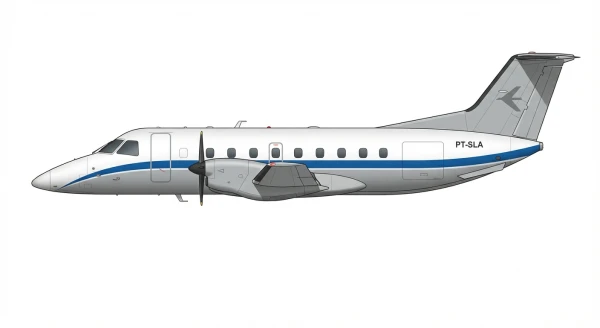
| Length | 20 m (65.6 ft) |
| Wingspan | 19.8 m (64.9 ft) |
| Height | 6.4 m (20.8 ft) |
| Wing area | 39.4 m² (424.1 sqft) |
| Empty weight | 7,070 kg (15,587 lbs) |
| Max. takeoff weight | 11,500 kg (25,353 lbs) |
| Powerplant | 2 × turboprops Pratt & Whitney Canada PW118 1,342 kW each |
| Maximum speed | 608 km/h (378 mph) |
| Operational range | 1,750 km (1,087 mi) |
| Service ceiling | 9,083 m (29,800 ft) |
| Takeoff distance | 1,420 m (4,659 ft) |


Description
The Embraer EMB 120 Brasilia is a twin-turboprop 30-seat commuter airliner designed and built by Embraer of Brazil. It entered service with Atlantic Southeast Airlines in October 1985 and was acquired in small numbers by military operators for transport and VIP duties, including the Brazilian Air Force VC-97. It was the last turboprop-powered airliner produced by Embraer, with production ending in 2001.
Development
Embraer began work on a transport-category airliner in 1974 following the EMB 110 Bandeirante. The programme was initially part of the modular Family 12X, comprising the EMB 120 Araguaia, EMB 121 Xingu and EMB 123 Tapajós, with the EMB 120 conceived as a stretch of the EMB 121 sharing most components. Only the EMB 121 was built in its original form. The EMB 120 was redesigned in 1979 on the basis of operator feedback gathered at a Commuter Airline Association of America convention, dropping the Araguaia name for Brasilia, retaining no parts commonality with the EMB 121, and initially reducing capacity from 30 to 24 seats. The original Pratt & Whitney Canada PW115 of 1,500 shp was replaced by the PW118 rated at 1,892 shp. The PW115-powered prototype first flew on 27 July 1983. Deliveries of the extended-range EMB 120ER began in 1993, after which it became the standard production model. Production ended in 2001. As of 2021 Embraer had not produced a turboprop successor.
Design
The EMB 120 has a circular-section fuselage, low-mounted straight wings and a T-tail. The fuselage is semi-monocoque with aluminium alloy skin, while the wing uses a single three-spar structure attached to the lower fuselage frames; the nose cone, dorsal fin and wing and tailplane leading edges are Kevlar-reinforced glass fibre. Hydraulically actuated retractable tricycle landing gear is fitted with Goodrich wheels, oleo-pneumatic shock absorbers, a Hydro Aire anti-skid system and carbon or steel brakes. Power comes from two PW118, PW118A or PW118B turboprops of 1,340 kW each driving four-blade Hamilton Standard 14RF19 constant-speed fully feathering propellers, with a Garrett GTCP36-150 or Sundstrand Turbomach T-62T-40C7E1 APU. Avionics comprise a Collins analogue flight instrument system or a Collins or Bendix five-screen EFIS, with dual autopilots. Maximum speed is 608 km/h at 6,100 m, cruise 552 km/h, range 1,750 km with 30 passengers, and service ceiling 9,085 m. Maximum take-off weight is 11,500 kg.
Operational History
Most sales went to operators in the United States and the wider Western Hemisphere. SkyWest Airlines was the largest US operator with more than 62 aircraft around 2006, retiring the fleet in early 2015; other US users included Great Lakes Airlines and Ameriflight, which still flew ten freighters in 2022. European customers included Régional, Atlant-Soyuz Airlines, DAT and DLT. African operators adopted the type widely, with charter operator Sahara African Aviation flying up to nine EMB 120ERs. Military operators include the Brazilian Air Force (20 transports), the Uruguayan Air Force (two) and the Angolan Air Force, which received new-build aircraft in 2007. As of July 2018, 105 remained in airline service.
Variants
- EMB 120: Basic production version.
- EMB 120ER: Extended-range, increased-capacity version, convertible to EMB 120FC or EMB 120QC standard.
- EMB 120FC: Full cargo version.
- EMB 120QC: Quick-change cargo version.
- EMB 120RT: Reduced take-off weight transport version, convertible to EMB 120ER standard.
Frequently Asked Questions
What type of aircraft is the EMB 120 Brasilia?
What is the maximum speed of the EMB 120 Brasilia?
What is the range of the EMB 120 Brasilia?
When did the EMB 120 Brasilia first fly?
How many EMB 120 Brasilia have been built?
Which countries operate the EMB 120 Brasilia?
How much does a EMB 120 Brasilia cost?
What is the service ceiling of the EMB 120 Brasilia?
- AUG 302026 Updated Description updated
- APR 72026 Updated Picture credits updated in a site-wide editorial pass
- JAN 122026 Updated Range updated in a site-wide editorial pass